Author: Elke Riesterer

  • Visiting Elephant Haven in France

    Visiting Elephant Haven in France

    This post is by Elke Riesterer.

    Nestled in a beautiful pastoral landscape is Europe’s First Elephant Sanctuary, Elephant Haven. I have been very excited to visit this place knowing many elephants live in captivity in various states of the EU. Practicing body therapy for all species (human and non-human) for over 25 years, my special dedication has been elephants. Confinement to a life in zoos, circuses and other entertainment venues has caused these highly intelligent mammals physical, mental and emotional stress. My work has brought me to countries in Africa and Asia where both species experience substantial harm to their well-being. Thankfully, increased awareness and activism over the years have led to the establishment of Elephant Sanctuaries. Yet, the word “sanctuary” has been often misused, so one needs to carefully look to ensure it refers only to an ethical place – with an absolute dedication to the NEEDS of an elephant and not the desire of people to touch, bath or ride them.
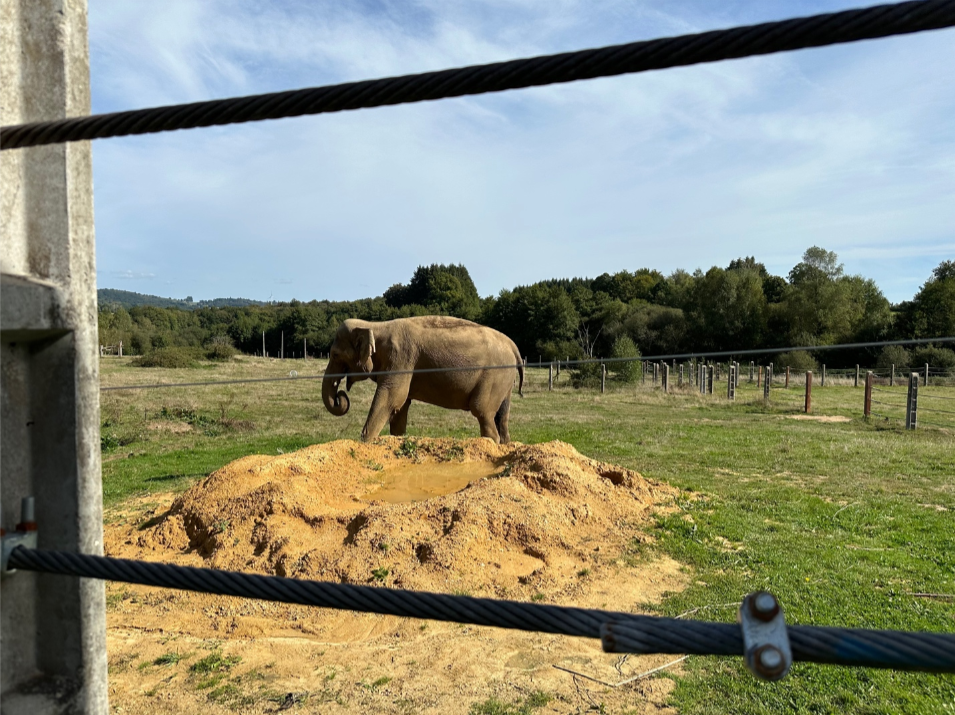
    Toni and Sofie are just that kind of people who want to provide the two resident elephants in their care – Gandhi and Delhi – with the very best. Meeting these two elephant ladies was the highlight of my trip to Europe. I followed the Elephant Haven facebook page regularly to familiarize myself with this exciting project of manifesting a peaceful and compassionate place for European elephants to be sent to for retirement. Observing Gandhi for a while next to a big pile of beautiful, elephant-loved dirt while chatting with Sofi warmed me up to the hands-on healing work that I am devoted to share with caretakers wherever I go. Our bodies, human & animals alike, hold memories of neglect, abuse, and torture of any kind in the vast terrain of our emotional, mental and physical being. Body-centered modalities like “TTouch” are wonderful, gentle ways to be calming, building trust, and allows the body to
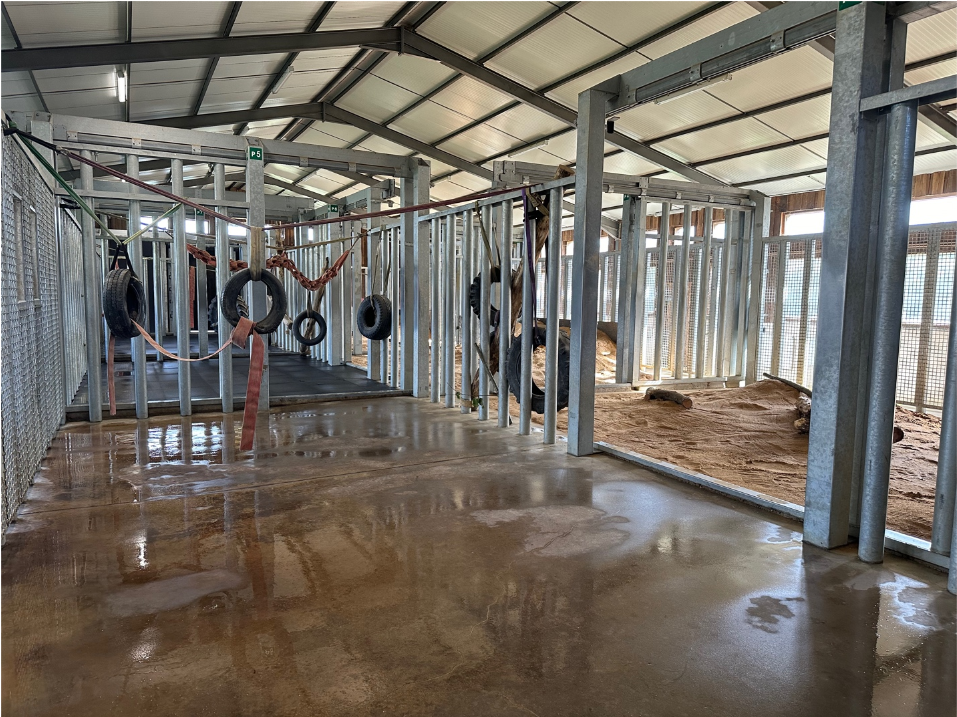
    restore itself on a cellular level. We decided first for Delhi to be introduced to my work. In the spacious barn she received treats of apples, carrots & veggies as I approached the protected barrier. Sensing her personality I asked Toni to position her so that I could touch her. Kindly positioning an elephant is part of husbandry training that all captive elephants go through in order for their body to be inspected of anything concerning health and in particular, for foot care.
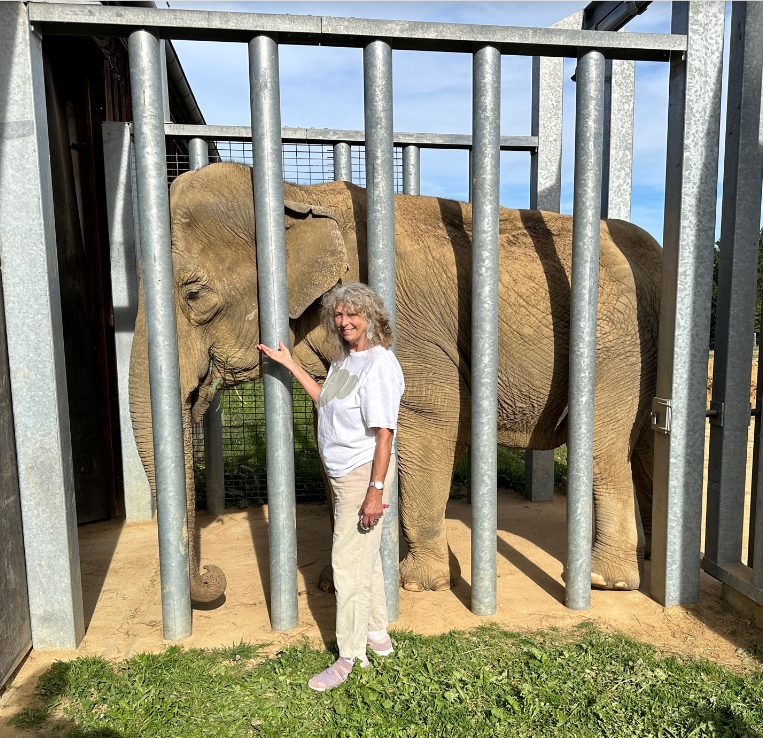
    Unnatural living conditions can cause often great damage to the toenails and foot pads. As I put both of my hands on Delhi, feeling her wrinkly skin, I was sensing a lack of groundedness. I paused a long moment, before I made soft, mindful circles, inch by inch, toward her tail. It was there near the buttocks she moved slightly away telling me that she was not sure accepting being touched on the area, holding presumably on to some internalized fear. I slowly stepped away and got myself a pole to use as a neutral tool to stroke her at the area. It went momentarily better but she needed more time to learn that I was not going to harm her. I learned from Sofie that where she came from in Asia sadly her tail hair got pulled out to make bracelets. Toni threw her treats again and asked her to turn and put her back foot on the bar so that I could demonstrate the TTouch on this important part of her body. This went very well and Delhi showed me the signs of relaxation that I particularly pay attention to. She started slowing down on eating and then stopped chewing completely, an indication that she was feeling comforting sensations. That is when deeper relaxation takes place, and stimulates the release of the brain chemical Oxytocin, also called love hormone. Mindful touch, positive physical interaction, facilitates wellness in all species and can be a bonding experience.
    Elephants are very tactile creatures, as can be seen on the many touching wildlife documentaries that are available in the media. Gandhi was next to be tended to. We went outside next to the barn where a suitable place was provided to introduce myself to her. This elephant lady was easier to approach with Sofie standing next to me feeding her treats while I used gentle TTouches on her face and then her torso. Gandhi was the first resident and therefore has been settling into her new home longer. You can read about the detailed history of both elephants on the sanctuary website. Gandhi was nicely receptive as I kept addressing her body, very sweet. As with many other elephants I wanted to show massaging the tongue and we moved inside the barn for this. I usually like to use a piece of banana for pleasing the tongue through a unique combination of massage highlighted by taste. In my experience, this is much loved by most elephants.
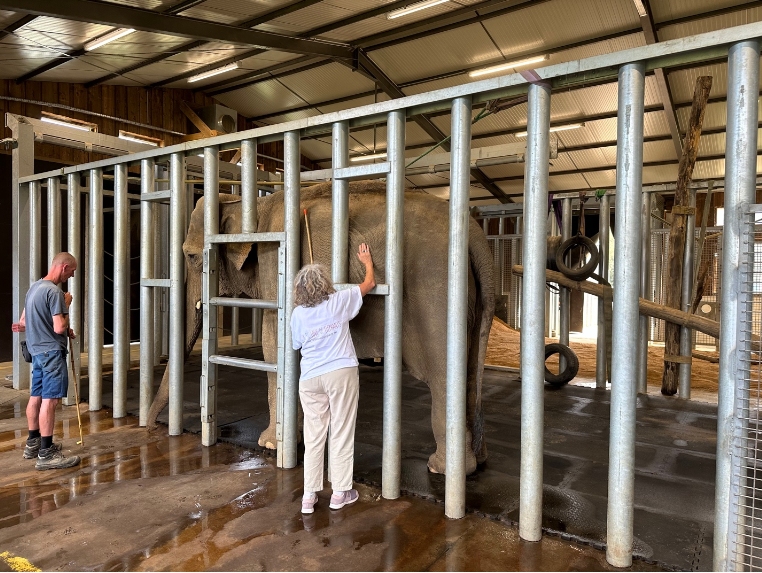
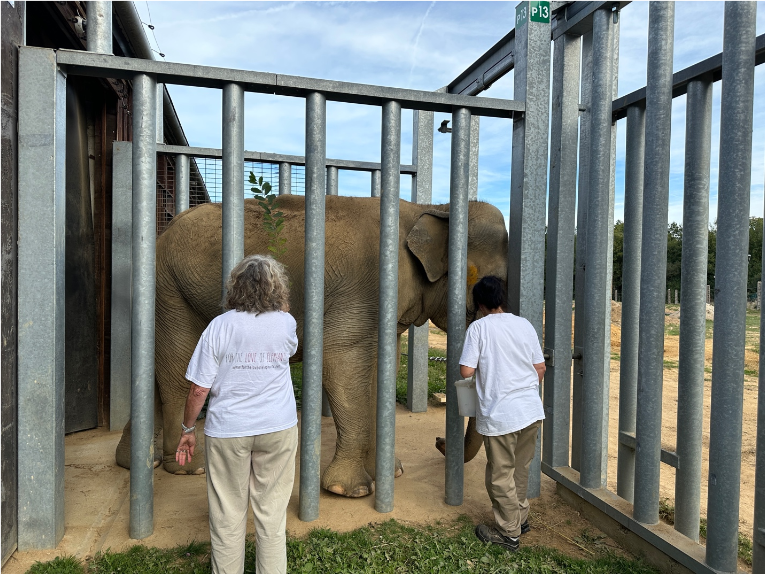
    Saying good-bye filled my heart and soul knowing that these elephants are in very good hands and hopefully many more of these magnificent mammals eventually find their way to this sanctuary.

    Videos of my interviews with the founders of EHEES — Part 1, Part 2.
    Elephant Haven (EHEES) website

  • Nutritious Food vs Junk in the Trunk

    Nutritious Food vs Junk in the Trunk

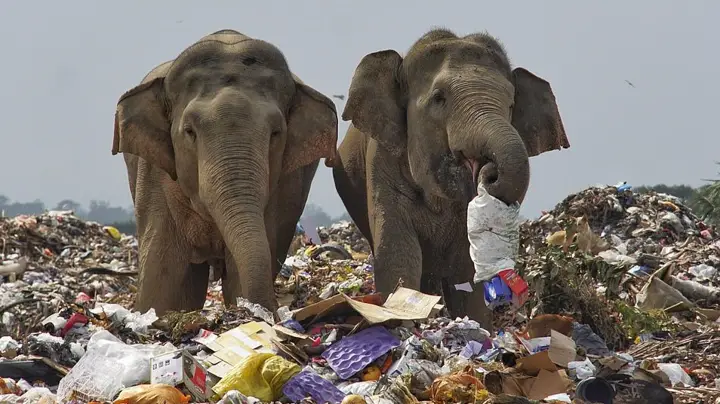
    In the wild, elephants eat mostly grass, wild fruits, twigs, shrubs, bamboo and a variety of plants. Their main food source is grass when it is available to them. Elephants will also happily eat tree bark, plant roots and even soil. Elephants are herbivores and roughly digest only 50% of their food. Elephants are known to have a sweet tooth and they like sugar cane, bananas and watermelon which are all nutritious. It has been observed that wild elephants
    make their way to the dump in search of edibles. Human garbage dumps can provide some suitable food that elephants find pleasing to their palates, for instance fruit and veggie scraps.
    See the paper “The elephant at the dump: how does garbage consumption impact Asian elephants?”

    A note here on this topic: It is a myth that elephants like peanuts. Hungry elephants raid crops of farmers in Asia and Africa. Human Elephant Conflict (HEC) has become a substantial dilemma. Farmers in India, for instance, make alcohol out of rice and grain which has some times resulted in another problem – drunk elephants. The mammals break in where the alcohol is stored and helping themselves to the dismay of the farming community. HEC has to be dealt with so that the run-ins between the human and non-human species can be hopefully solved.

    On the topic of captive elephants’ food consumption, it’s a habit of many people to give handouts to these beautiful giants. As one source told me, bread and biscuits, still wrapped in plastic paper, are some times given. In a zoo in Japan, flowers (perhaps contaminated) have been fed. Two elephants died and others got ill.

    Sangita Iyer has recently covered this issue in-depth: What Kind Of Monster Would Feed Meat To An Elephant?

    In the good old days, most Hindus did not eat meat, however, things changed after people from India began migrating to western countries. People can eat whatever they want, but the audaciousness of religious institutions to feed meat to a herbivorous animal, that too a cultural icon glorified as the embodiment of Lord Ganesh, is simply intolerable.

    The thought of meat given to strictly vegetarian elephants is as crazy as ground up meat particles that has been given to cows who are herbivores like elephants. Where are the boundaries and respect of the nature of the animals’ biology? In addition, I want to point to mahouts drinking alcohol at the Indian temple festivals, and that some elephants purposely have been given alcohol, perhaps to calm a potential musth bull during the loud and elaborate temple festivities. It is known that alcohol addiction is an issue that a number of mahouts harbor. Elephants also suffer when they are given poor quality of nutritious food like lots of palm leaves and not much else and lack of adequate water. In my humble opinion this could cause serious health problems. I personally witnessed cases of intestinal impaction that were deadly. Giving only one or two kinds of food would be considered malnutrition. Many captive elephants get cultivated food that is chemically contaminated, which could compromise their health over time.


  • Attending CITES

    CITES is a large world-body of an organization and stands for Convention on International Trade

    In Endangered Species of wild fauna and flora, aimed to ensure that international trade in specimens of wild animals and plants does not threaten their survival. Meetings are held every two to three years somewhere in one of the worlds big cities.

    I have been to 4 of these 10-day events. The first one was in 1977, when I traveled to Harare/ Zimbabwe to be an observer for the Oakland Zoo. I paid for my own attendance because I was immensely curious what this international body is all about. Having personally such dedicated interest in elephant welfare and protection I was spiritually pulled to go.

    The opening was a spectacular display of cultural performances that kept everyone smiling and clapping. Then president Mugabe opened the conference with a spirited speech.

    It was a high-profile conference with heavy focus on elephants. The ivory sale was hotly discussed, emotions ran high and Zimbabwe fought hard for sustainable use. Basically, that means the elephant has to pay for its way to be protected. The people of the country should benefit from the sale of ivory in order to help for their conservation. That was the opinion and mood of many of the delegates, especially the one from Zimbabwe which was large in numbers and full of passion. I will never forget witnessing such strong display of emotions that run so unleashed through the halls of the conference. It was strangely electrifying, I must admit, to find myself amongst delegates who rooted for something I had no heart for.

    At that time the conference had about 134 countries (now 184) participating. Each country sends a delegation numbering in the range from 2 to 20 people. Besides the government delegations many wildlife NGO’s are also present. NGO’s are holding meetings and presentations to sway delegates to vote more heart-centered to protect especially vulnerable species. Giving voice to an animal’s right to be respected, saved from exploitation and not viewed as a commodity. I met many world leading figures in elephant conservation. One in particular, Vivek Menon, head of Wildlife Trust of India, became a friend and invited me to practice bodywork on captive Indian elephants.

    CITES is a dysfunctional entity where countries with great economic power entice a poor country to vote for a certain proposal in exchange for financial help and investment. It was depressing to sense and hear about the amount of corruption that has been going on for years.

    My next CITES visit was in the year 2000 held in Nairobi/ Kenya. I had visitor status this time which did not give me access to all meeting groups but in the large committees I could sit in every day.

    Again, I went as a visitor to the 2007 CITES conference in The Hague /Netherlands.
    It was a deeply depressing conference with an agreement of an ivory stock pile sale.

    See data on the auction below.

    My last one was in 2016 which was held in Johannesburg/South Africa. As the previous ones,

    Elephant topics dominate and have been prone to the most stressful discussions. African nations like Zimbabwe, Namibia and South Africa have an on-going big interest in getting rid of their ivory stockpiles. Profiting from the Asian demand for ivory is a relentlessly strong drive by this southern African Countries. The wish to decide over their own resources is repeatedly expressed by their representatives.

    For instance, ivory stockpiles had been constantly pushed up for sale and so 12 years ago in 2007 a one-off sale of ivory was agreed on by the parties. It proved to be devastating for the African Elephant. Sadly, poaching went up dramatically, benefitting the poaching industry because of the difficulty identifying legal from illegal ivory. Poaching syndicates found often twisted ways with the help of corrupt government officials to smuggle the highly desired ivory to their customers in Asia.

    At the end of each conference the parties will vote on a long list of proposals and the result is supposedly binding till the next CITES date. Unfortunately, there are incidents, loopholes which are hardly addressed by this body. A lot has to do with the more recent years of shipping elephant babies from Zimbabwe to China. A cruel, traumatic act of hardship for this young, vulnerable, elephants and very upsetting. The bottom line is that it is a headachy and weak organization that has failed the species it was designed to protect. Enforcement is lacking, perhaps not even doable, unless CITES reforms.

    The 2019 conference, which I did not go to, produced a highlight for elephants which was greatly applauded and for some came quite as a surprise.

    Elephants from the wild will no longer be shipped to zoos and circuses around the globe, delegates at the 18th Conference of Parties (CoP) to the Convention on International Trade in Endangered Species (CITES) decided on August 27, 2019.Aug 28, 2019

    For the reader of this blog my focus has been on elephants only but CITES deals with many other species and I want to leave that to the specific interest of the reader to search for that wider information. Countless animal and plant species on this planet need help and engagement and I applaud anyone whose heart calls for activism.

    Here is a link to an opinion piece about CITES:

    Details about the auctions

    • At the first ivory auction, held in Windhoek, Namibia, on 28 October 2008 7,226 kg of ivory were sold for a total of USD 1,186,260.
    • At the second auction, held Gaborone, Botswana, on 31 October 2008, 43,153 kg of ivory were sold for a total of USD 7,093,550.
    • At the third auction, in Harare, Zimbabwe, on 1 November 2008, 3,700 kg of ivory were sold for a total of USD 500,000.
    • At the fourth auction, held in Pretoria, South Africa, on 6 November 2008, 47,356 kg of ivory were sold for a total of USD 6,703,000

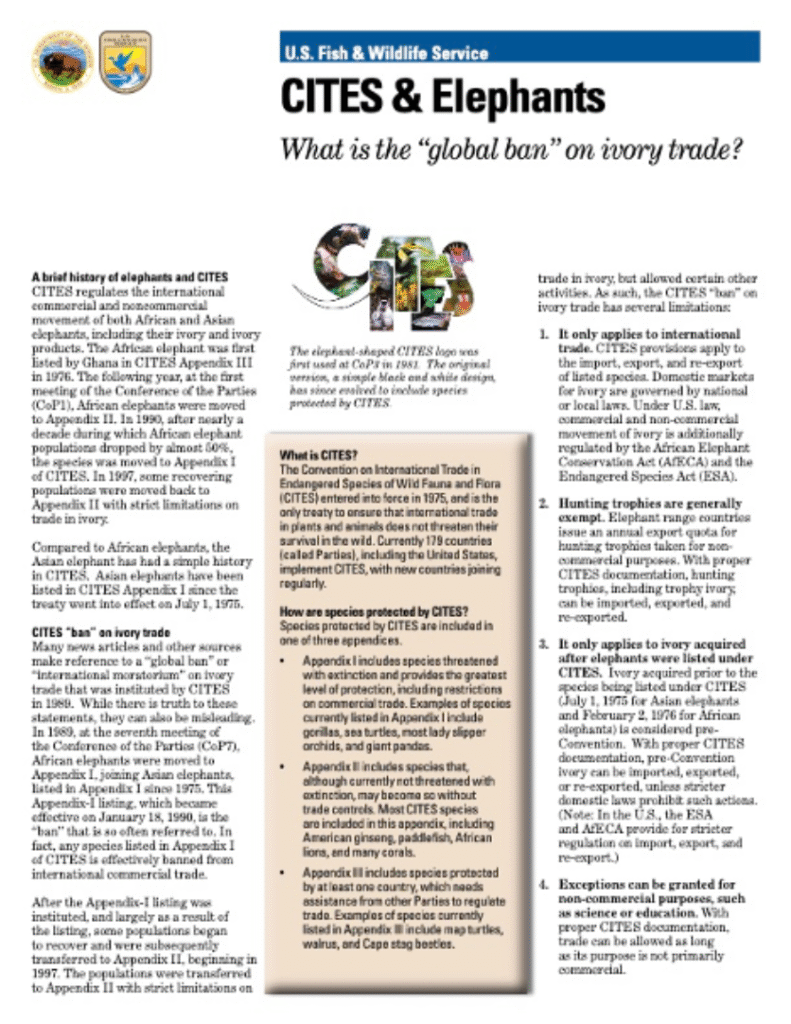
    And more Info from U.S. Fish and Wildlife:


  • International Candlelight Vigil For Elephants

    On January 4, 2020, World Elephant Alliance, along with 42 other groups from Australia to Zimbabwe,  participated in a commemorative service to honor all the elephants who died in captivity in 2019.  Ten cities held live vigils with hundreds of vigil goers in eight US cities and in Colombo, Sri Lanka and Cancun, Mexico. Many more held private vigils and shared their vigil photos online.

    The number of elephants who died in 2019 is estimated to be higher than the 37 that were commenorated, many more uncounted from Kerala, India for instance. At the vigils, each person read the biography of the deceased elephant, chronicling the sad lives of these captive elephants, who suffered and died in captivity for the purpose of entertainment and tradition. This second annual #vigil4elephants is growing fast. Last year, 8 groups took part, next year will see even more as news of the vigil spreads far and wide.