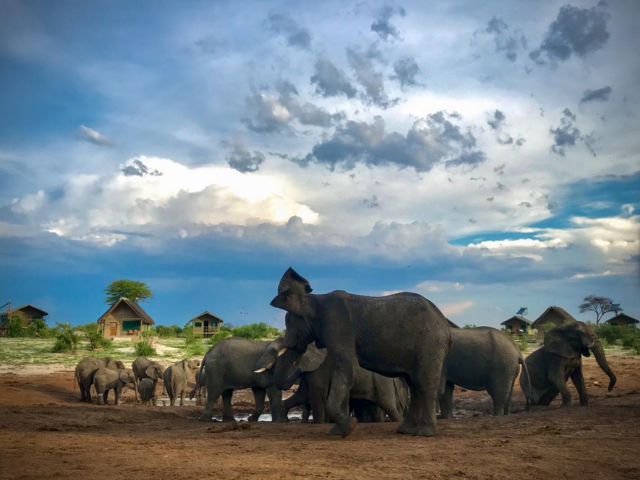
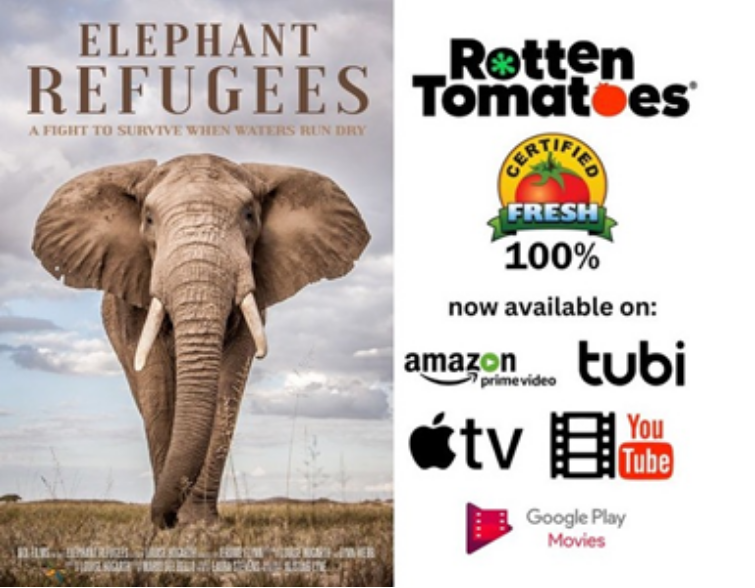
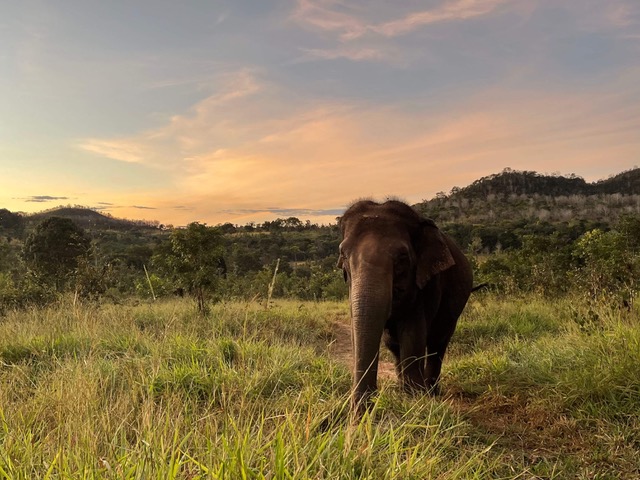
Elephant Sands is a modest lodge in Botswana which was started by Marie and Ben Moller out of their love for elephants. Tragically, Marie suddenly passed away a few months ago. Ben’s daughter and son-in-law do much of the heavy lifting now. Their story has been made into a must-see documentary titled Elephant Refugees. It is available on several streaming services including YouTube and TUBI for free without commercials. If you don’t have any of the streaming services, you can watch it for free on YouTube but with commercials. It received a rare, and well deserved, 100% on Rotten Tomatoes.
Botswana had become a sanctuary for elephants due to its ban on hunting. The elephants would pour in from all the surrounding countries. Botswana has the highest population of elephants of any country in the world. Elephants knew they could safely travel to Elephant Sands to find water. They came from far and wide to survive—especially during times of drought.
All the water is trucked in to Elephant Sands three times a day by a double tanker. The road is sand and can’t support the weight of their tanker truck, so the Mollers built an 8.5 mile pipeline. Three Solar pumps in three locations outside of Elephant Sands are used to pump water 8 hours a day. If they had a more powerful pump that could work 24 hours a day, they could provide water for about 2,500 elephants instead of 800. When water is scarce, the elephants come first and the swimming pool for tourists at the lodge is emptied. Botswana being a safe haven for elephants all changed in 2019 when a new president was elected and he lifted the ban on hunting elephants. About 2.5 million acres surrounding Elephant Sands is now a year-round killing field. The government cited lifting the ban on killing elephants due to overpopulation of elephants, human-elephant conflict, destruction of crops, and the millions of dollars permits could raise for the country.
The elephants still come looking for water. But now they are aggravated and traumatized by seeing their kin being killed. Elephant Sands is not in the delta region where most tourists go to the swanky lodges, but in Nata, in the middle of nowhere. Booking tourists is critical to being able to afford water but you can help without making the trek to Nata.
The Moller family does so much with so little. Will you help them afford a more powerful pump? You can donate through Elephant Refugees filmmaker’s website to get the U.S. tax deduction. (Please designate that your donation is for Elephant Sands). The filmmaker can also be reached via Facebook.
If you choose to contribute directly to Elephant Sands, you may write to them by email for the bank details for WATER FOR ELEPHANTS TRUST.
As a consultant with Global Sanctuary for Elephants in Brazil, I spend a couple of months a year there. I also helped with the last 4 transports to the sanctuary. In addition, when I am not there I consult remotely with Kat and Scott almost daily about other vet cases as they come up at the sanctuary. I first came to GSE with Lady in Nov 2019, meeting her at a zoo on the east coast of Brazil and then traveling 5 days together across Brazil to the sanctuary. It was pretty amazing to take the journey and travel the road to the sanctuary as Lady saw it for the first time.
Words can’t describe the magic of the sanctuary. The land in Brazil is so quiet and secluded with macaws flying overhead and amazing sunrises and sunsets and a sky full of stars on clear nights. Lady walked right into the container without any problems. Little did I know how difficult each additional transport would be. In comparison, in September 2020, Bambi was only a three day journey away from the sanctuary but getting her into the transport container was much more difficult than Lady.
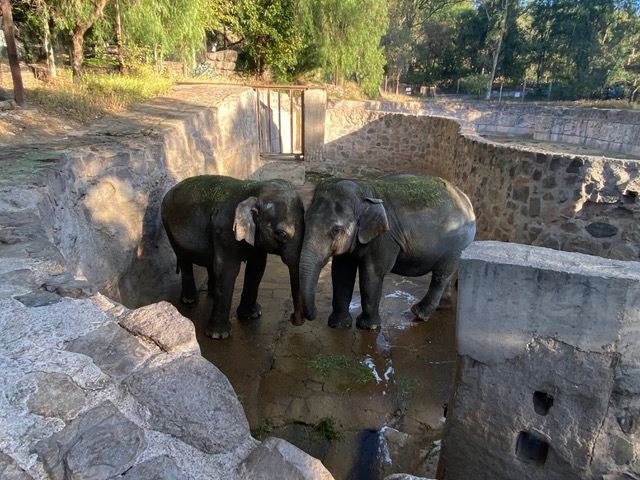
Last morning at the Ecoparque — Pocha on left, Guillermina on the right
I first met Pocha and Guillermina – a mother-daughter pair, in August of 2021. After a mandatory 10 days in quarantine in Argentina, we had 10 days to get them in their crates loaded and across the border into Brazil before the CITES permits expired. Shortly after arriving at the Ecoparque in Mendoza, it became apparent the girls were not used to going in the crates and so we knew we were up against a big hurdle. First, we moved the crates so they were back to back instead of in two different areas of their enclosure. Pocha quickly started coming in all the way to the front and Guillermina would come in with two feet into the second one. So we went for closing Pocha in and hoping Guillermina would face her fears and run after her mom but we were wrong. We waited all night and tried moving Pocha’s crate a little bit but Guillermina was not ready to leave. As we could not move Pocha without her daughter, we decided to stay and keep trying to get the girls comfortable In the crates while we waited for CITES permits to be renewed hoping it would take 4-6 weeks to get the new permits.
Watching and listening to the two of them being reunited that night after being separated by gates for only a couple hours really hit me hard because that is how every elephant in captivity must have felt when they were taken from their mothers. Luckily, Guillermina will never be taken away from her mother. About a month after we first tried, on her own Guillermina started backing all the way in surprising us all and Pocha started following her in. We kept waiting for CITES permits and eventually a petition had to be started to convince the Argentina government to approve the move of the girls. I left them in October to return to my two elephants in Nepal hoping I would be coming back to move mom and daughter soon. It was very hard to leave knowing these two were still stuck in their concrete dungeon. But as one supporter said freedom delayed is not freedom denied and this kept me going during the next 7 months.
I was visiting GSE in April when we got the sudden news that the permits had been issued. Within a week of issue the team had assembled in Mendoza and the girls were still hanging out in their transport crates, now more comfortable and ready to move. We were all still nervous if we could indeed close both elephants in their individual crates. Closing the girls in their separate crates went amazingly well. I think they were both ready to go. We loaded Pocha on first to go backwards and then Guillermina second to ride going forward facing her mom.
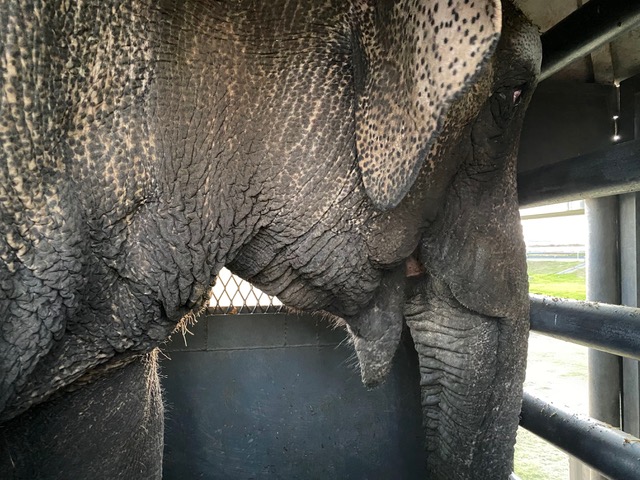
Pocha in her container on the road at a rest stop
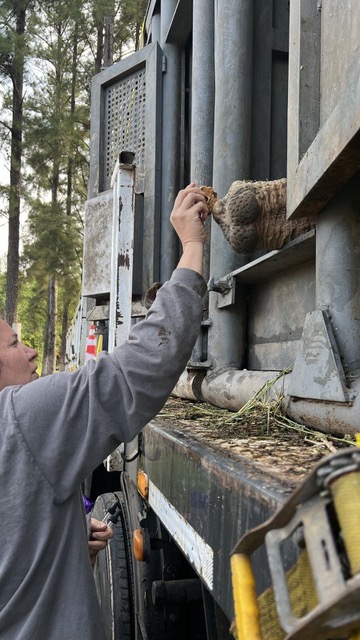
I find the first 24-48 hours with all the girls can induce motion sickness. Guillermina started out eating really well. Pocha was very picky but then they switched as the long 5 day journey went on. Guillermina became more anxious and was eating less and Pocha settled into the groove of the road trip and became more affectionate, opening her mouth and showing her tongue which she does when she wants attention. Days on the road are long, trying to leave at sunrise and usually driving till 11 pm or even 1 am. We do stop every 3-4 hours to refresh food and water for people and elephants, but the longer we stop the longer the journey will take. So we are always trying to find the right balance of getting the miles in but also watching to see what the girls need as the elephants can rest deeply only when we stop. After the caravan stops the girls still have to be fed and offered water but usually they were exhausted themselves and ready for bed. As the vet in charge of the elephants we travel with a 50 lb emergency bag of drugs and IV fluids, everything and anything we might possibly need if we had an emergency anywhere along the road, which is often not near any town. It is a bit nerve wracking to have such precious cargo under your care. Luckily all 4 elephants I have transported to GSE have all done well and not required any medical interventions but we are ready to treat any abdominal pain/colic, pain, allergic reaction, dehydration, etc. We use essential oils around the containers to help with the transition and journey and the elephants get flower essences to help them deal with the emotions and I do think these two modalities help make a big difference. I like to get the girls different sweet treats at the truck stops: cookies, dried fruit, juices, fruit popsicles, etc. just to keep them excited. We also use ginger candies for motion sickness. Scott is in charge of all the logistics and my priority is to make sure the elephants are remaining as calm as they can be and physically mentally doing well as we move the containers from the ground to the trucks and on the road.
Pocha reaching out to grab cookies and flower essences at a food-water break
When moving Lady and Bambi we had two cars following the elephant truck and police escorts in front.This time with two elephants we had two trucks (one just to carry food and supplies), two police escorts, a van from Ecoparque Mendoza with previous caregivers, and two cars following the girls. At the Brazil border we were met by ESB staff and volunteers, our typical transport crew and so two more cars. We also had 7 photographers in total documenting the journey!
At the border we had to clean both crates thoroughly as possible to not bring anything into Brazil from Argentina. Scott , Ingo and two caregivers from Mendoza and myself stayed up all night cleaning the containers in the dark and the rain but also having a lot of fun, so excited to be at the Brazil border and hopefully just 2 days away from sanctuary! We drove through rural Argentina and Brazil where most people have never even seen an elephant even in a zoo. So when we stop for gas and to give the girls food and water we cause quite a spectacle but it’s a great time to educate people about zoos and the sanctuary in Brazil. And we meet lovely people along the way, some donating food for the people or elephants and even one gas station donating diesel for the trucks!
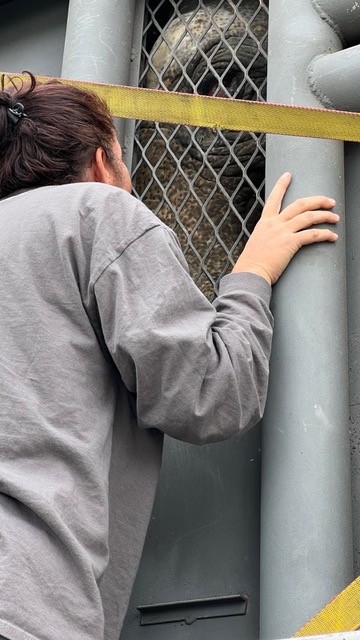
Talking to and checking on Pocha on the trip
Arriving at the sanctuary we all thought and expected the girls to come running out like Bambi did and I was really surprised how hard it was for both of them to leave the crates. But the crates which 7 months ago had been foreign, had now become home to both. Similar to people too afraid to leave their house, town, or country, it just shows the trauma elephants have been through and how we all process things at different speeds and ways. I thought I would cry when the girls came out of their crates but it took so long for them to leave, I was just too exhausted to feel anything but relief that they were both out and safely delivered.
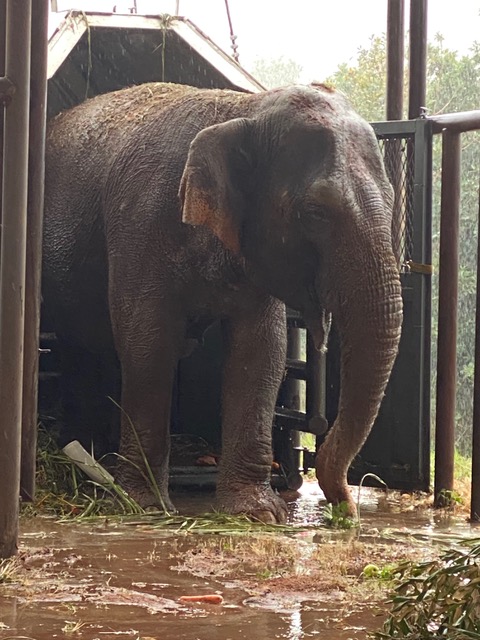
An unexpected rain storm led to first mud bath at the sanctuary with two feet out of the container
It has been amazing to work at GSE with Scott and Kat and Ingo and the rest of the Elephant Sanctuary Brazil team. We all brainstorm together what to do next watching and listening to the elephants and keep trying new things to help them feel comfortable with their transition to life at the sanctuary. I was with them at the sanctuary for a week and it was so interesting to watch them both get the courage to leave the barn, often they both felt comfortable leaving only when we would all leave and stop staring at them. But we could still watch them on the cameras from the office. It has been amazing to watch their transition these past two months with everyday bringing new firsts — feet on the grass, covered in dirt, grazing on grass themselves, breaking trees, finding the mud wallows and pond and meeting five new friends. I can not wait to get back and see them again and bring more elephants to the sanctuary.
This is a guest post by Steve Koyle of Elephant Care Unchained.
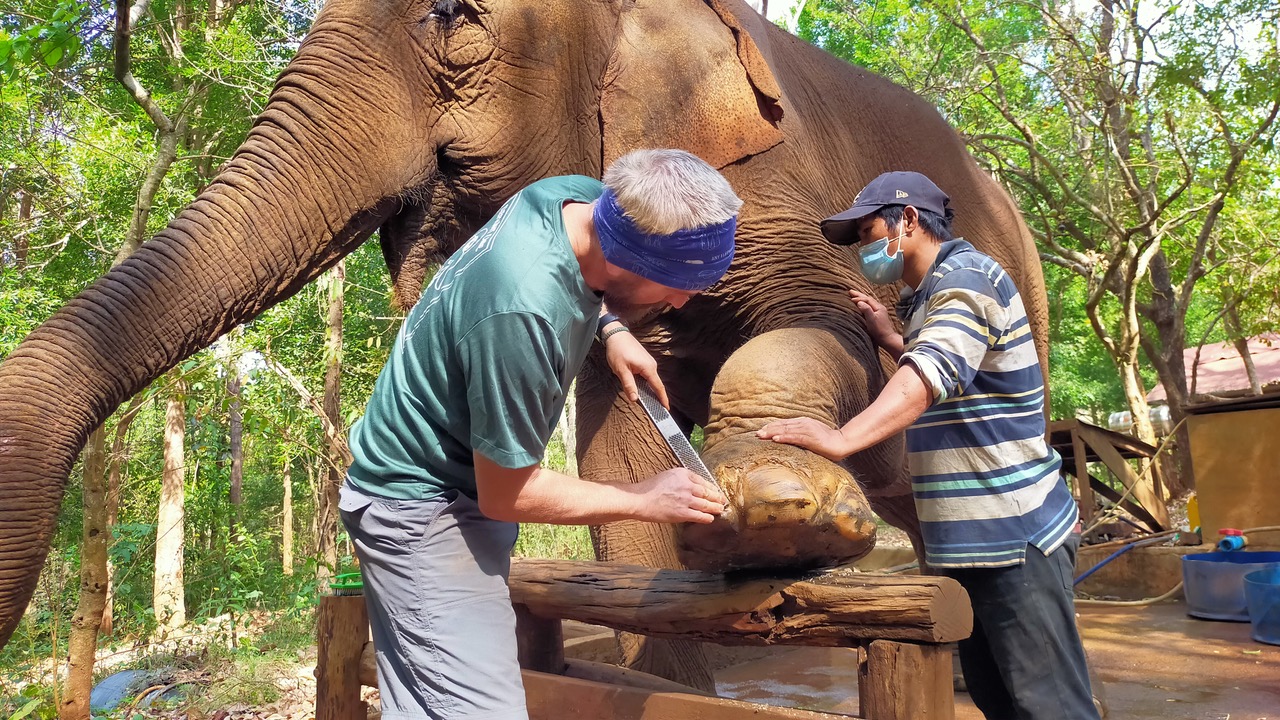
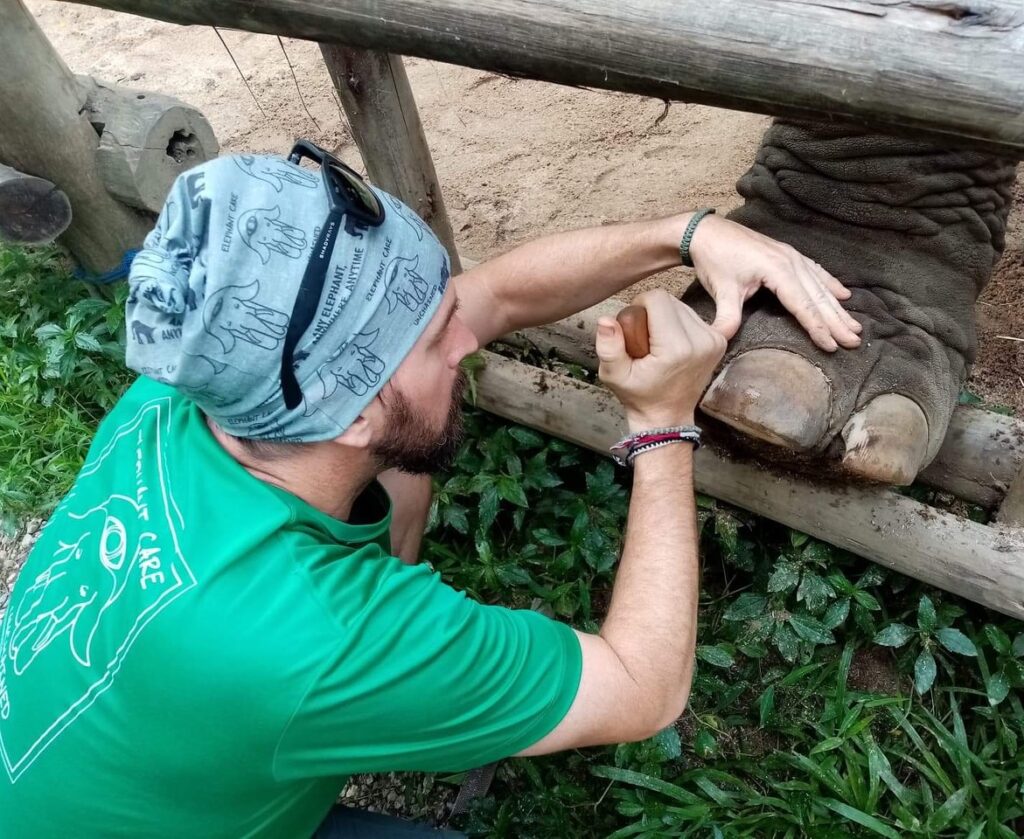
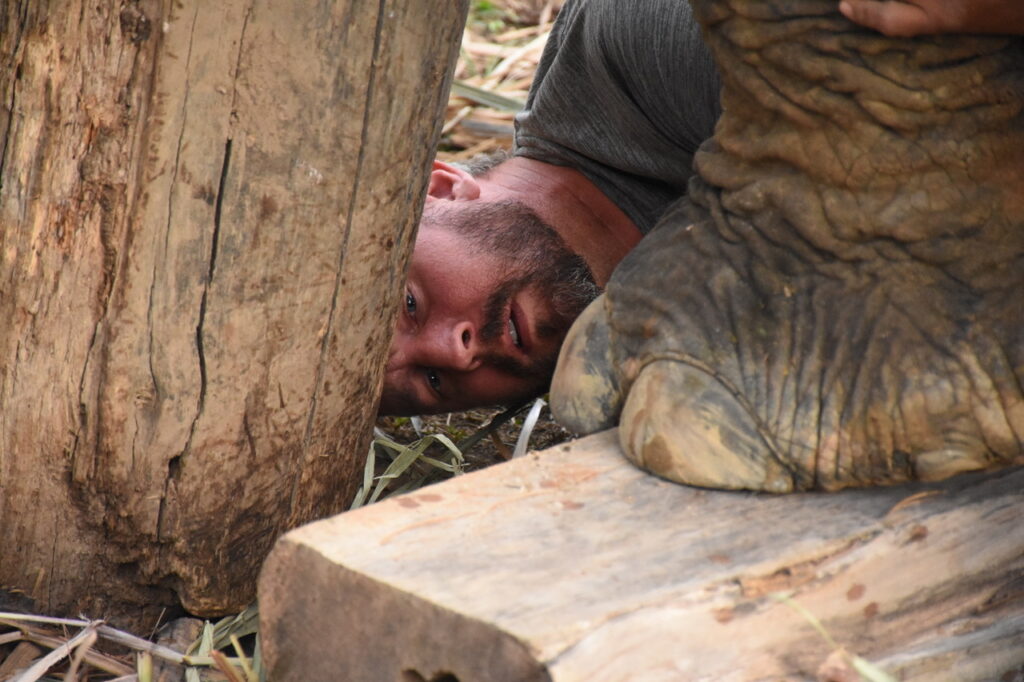
The captive elephant is a tragic story. Throughout my 20 years of caring for elephants I’ve seen and witnessed a lot of pain and suffering. More so since I’ve established Elephant Care Unchained in 2016. Over my 20 years of working for elephants I’ve developed a special skillset that has allowed me to improve the captive elephant life regardless of situation or environment. One skill that I’ve become globally recognized for is footcare. You can tell a lot about the elephant simply by examining the feet. If the elephant has healthy feet, it probably has a healthy environment. Ultimately, the elephants are the easy part, the challenge is the people in charge of caring for them.
Throughout this journey the hardest part is earning peoples trust to gain access to elephants. It’s not an easy task, it’s kind of like a travelling salesman going door to door. In my case, going from elephant camp to temple to zoo to park to try to establish trust with the hope of helping elephants. There are many obstacles to overcome when working in native countries. First is the language barrier. As I travel anywhere in the world to help elephants (currently 6 countries) and try to explain a totally new concept of welfare and compassion is hard enough, especially in a different language. Communicating is
difficult and things get lost in translation. I believe that they think “What does a white guy from the west know about elephants?”
Second is education, most of the mahouts are uneducated and abuse substances. When I explain a “simple” concept either enrichment or substrate that will help improve welfare the message is lost. “If you don’t think anything is wrong then why change it?” For example, elephants’ displaying stereotypic behaviors is just “normal” to most, so in their mind “why change it?”
Third is understanding and working within the culture. Unfortunately, in many cultures elephants are exploited and mistreated under the disguise of culture. How can you help without criticizing the culture? The moment you criticize or insult culture you have no chance of helping. It’s about trying to be more understanding and earning trust. Another cultural obstacle is that, so often us westerners are quick to criticize without really knowing what is going on. This makes helping more difficult since most of the mahouts’ experience with westerners is either to hug and kiss the elephants or publicly criticize their care. Both of which are not helpful to the elephant or their welfare. Understanding the mahout’s situation is another difficult obstacle. Many mahouts are
paid a minimal salary and therefore use the elephant to make money. In doing so, they usually put the elephant into an unnatural and unsafe environment which is very dangerous for them and harmful for the elephant. Elephants do in fact hurt and kill people. So, we must understand that it takes much more than hugs and kisses to care for them.
Lastly, teaching compassion is the extremely difficult. How do you do it? How do you make people care about the elephant as a living being with needs? It’s so emotionally draining to be out here fighting for elephants and improving their welfare. To see people beating and neglecting the elephants makes most days very hard. If only they would apply a few simple suggestions, life would be much easier for everyone involved. The reality is that until elephants’ stop being used as money machines and the cultures change their attitudes toward them. It’s going to be a long road to end the unnecessary suffering. It’s a road that I will forever be on fighting for elephants.
Working with and, more importantly, for elephants is an extraordinary life, and providing them with the freedoms of sanctuary leaves us at a loss for words to describe the depth of gratitudewe feel. With all of the celebrations of new beginnings that come with a life at sanctuary, witnessing the growth and healing of these sentient beings who have been profoundly damagedin captivity, there is an unspeakable joy in seeing the light return to their eyes; there is an equal,complicated emotion surrounding the difficulties and challenges of running an elephant sanctuary. After 16 years building and developing The Elephant Sanctuary in Tennessee, Ineeded to step away. Kat and I took on a quiet life for a short time, and it too was a glorious life. We looked forward to the ease of stress and constant worry, but I didn’t anticipate theperspective and clarity that came with our return to “normalcy.” When you provide care for suchhighly intelligent and emotional beings, particularly with the complexities of their emotional and physical recovery, they are always in your mind. Not having the constant worry was welcomed and necessary.
Shortly after leaving the Elephant Sanctuary in Tennessee, we received a desperate call to help remove Ramba, the last performing elephant in Chile, from the circus. Two prior attempts to move her had failed and, on the day after Christmas in 2011, the judge for her case set a limit of 10 days and offered one last chance to move Ramba, or she would stay with the circus for the rest of her life. Her relocation was chaotic but successful, and was the first step to her eventual transfer to sanctuary which, at the time, was slated to be the sanctuary in Tennessee. About one year later, with Ramba still residing in her temporary home, and with our renewed perspective on the gifts elephants bestowed on us, conversations for a new venture on our part began.
Some of our colleagues had been working in South America, principally in Brazil, where progressive legislation regarding captive animals was being enacted. No current alternative existed, but they knew sanctuary was the only viable future for an increasing number of soon-to-be-displaced elephants. Almost immediately, we realized they were right, but we honestly hadn’t considered starting a new sanctuary until that point. There is so much to take into account when you go down that road of thought, because you know what challenges almost certainly lie ahead. And, more importantly, we knew the toll it can take on our own lives. Even when you think you know the difficulties you’ll face, so many roadblocks emerge that you don’t anticipate. Long conversations were had in our home about the effort it would require from us, knowing that the next step is not one of “let’s see what happens.” Beginning a sanctuary means you are all in – but, after witnessing some of the things we’d seen in the eyes of elephants we’d cared for in the past, there was an unstoppable pull towards creating a new home for the elephants we’d met here.
When we first arrived in Brazil to start building Elephant Sanctuary Brazil, we were told that land was already available, as was $300,000 in funding, a car, and a place to live. The funding immediately fell through, and the property did the same shortly after. The car was going to be given by the Brazilian government, but was tied to having the organization up and running. No sanctuary meant no car. But the government was still supportive and provided us housing, which wasn’t ideal, but they were making some effort. From our first days in Brazil, zoos asked for advice and prosecutors were inquiring when we could come to relocate elephants in their jurisdiction. Although countless bureaucratic hurdles lay ahead, the situation was unique, where virtually everyone we met, from public authorities to zoos, wanted sanctuary for their elephants. There was a groundswell building around the issue, but no infrastructure in place.
Even with these positive ideas emerging, other significant and often deflating roadblocks continued to pop up. We found tracts of land that may have worked for a sanctuary, but paperwork is different in South America than in the US. Areas that might have been a good fit weren’t documented, the documentation was falsified, or landowners would change their minds and decide not to sell. Brazilian bureaucracy was slow moving and difficult to maneuver, and the entire regulatory body had no idea how to categorize an organization like ours, because we were the first sanctuary of our kind. What little personal funding we had was drying up. At that moment, we looked at each other and pondered, “What are we doing here?” When everything logical said to turn back, with Ramba, Maia, Guida, and many others in desperate need of a new life, it was impossible to walk away. When you know what we know – the level of healing that occurs in a sanctuary setting, the level of transformation that starts from their very first steps onto sanctuary grounds, – there is no turning back once you begin.
We made the difficult decision to alter our original plan. Following an exhaustive search, we fell in love with a property in the municipality of Chapada dos Guimarães, Mato Grosso. The weather in the area was lovely, the land itself was gorgeous, and there was so much about the space that would be stimulating for elephants; of the hundreds of farms we explored, this was one of the most diverse and protected – truly idyllic for sanctuary. Brazilian custom is to pay for land up front, rather than in installments as you might in the US. And, bank loans for non-profit organizations require an individual to fully financially back the loan in the event of default. As we pondered how we could make this work, something just short of a miracle happened: the local landowner was willing to help, based on nothing but good faith and a dream. This man didn’t know of the success of the elephant sanctuary in Tennessee. But he had a big heart, some blind faith and, once he understood what we wanted to do, he wanted to be a part of something that would truly save lives.
There was absolutely no way we could have taken on the task of creating this elephant sanctuary without knowing the significant work that lay ahead. Without our prior knowledge and decades of experience of sanctuary, we would never have pursued moving forward. Our eyes were open and we readied ourselves for the days we knew we’d have to push onward, through almost insurmountable obstacles, but with confidence the project would change lives. We jokingly say that we have just enough faith to continue on when logic says to turn back, but the truth is that we know the difference that genuine, spacious, and autonomous sanctuary brings to the lives of the elephants.
Elephants are beautiful, sentient beings with deep emotions, intelligence, the resilience to endure, and the capacity to heal, and even forgive. This sanctuary is built on the belief that elephants deserve a better life. Captivity, confinement, and isolation for the entertainment of humans has nearly destroyed these precious lives. Sanctuary heals. Freedom gives captive elephants the chance to learn who they really are and what it means to be an elephant. We continue to face challenges, but so has every elephant we meet, to a much greater degree. If they have the courage to forgive, heal, and keep going, then we owe it to them to do the same. It is up to all of us to right the wrongs of the past through our united efforts to make tomorrow a brighter place for all.
Mahatma Gandhi said, “The greatness of a nation and its moral progress can be judged by the way its animals are treated.” No? This rings more true today than ever before with the transparency documented online in the world wide connected web. You see, there is no villain and no hero here as we are speaking about the ‘Elephant in the room‘, a scientifically proven sentient, altruistic and empathic being alone in a barred concrete enclosure in the middle of a loud bustling city. In this evolution of life we all make mistakes. It is a part of learning, but as we learn we compassionately do better for all, understanding that we too are nature, not apart from it. We are here to live the golden rule in this golden hour together ~ “do unto others what you would have them do to you”.
We are at a precipice of change coming together to make things better, for our health, for our home ‘mother earth’ and for each other. This is at the core of our evolution, releasing outdated methods that benefit no one, as is the obvious case of Ely the 41 year old African Elephant who is living an isolated existence halfway across the world from Africa. Living away from her herd where she was born into as a WILD animal, a keystone species, living her days amidst her matrilineal herd who in fact would never spend even a single day or night apart from each other. Ely was designed by God to be an elephant, not a suffering animal displaying to kids the disconnected nature of her tremendous misery. Again, there is no villain and no heroes here, this is humanity becoming more self-aware as elephants are scientifically proven to also be. This is us coming home to our true nature, kind to our neighbors, extending our hearts for Ely as a representative of the most grandiose ecosystem engineer on the planet!
Elephants are the most significant ‘Guardians of the Wild‘ as is Ely to our better nature and so we shall come together in her healing and deliver her to the best possible natural living environment we can for her, among her own kind. Ely critically needs and deserves retirement to sanctuary to live out her days extending and lubricating her joints, by walking on vast uneven terrains massaging those gigantic feet and stiff arthritic joints that have nearly ceased due to inadequate food, standing day in and night alone in a small concrete holding cell. In nature elephants would forage 16-18hrs per day, browsing and grazing on a diversity of plants; it has been documented up to 307 different species, selecting their medicine of the moment straight from nature, from roots, shoots, charcoal to bitter herbs and barks. This massive herbivore requires an enormous amount of diversity, connection and natural activity, and sadly Ely has been deprived of all this her adult life.
Ely’s life story did not begin in this microscopic enclosure, speaking in elephant relativity, and we pray for wholeness on earth again for balance so that she will not end her days in this same extreme suffering. This was not God’s design for this prestigious masterpiece tasked with the ‘Keeper the Peace‘ on earth between humans and wild nature. More specifically, Elephants keep humans at bay on our edges of co-existence holding space for natural corridors and clean waterways protecting All of Nature, from flora, fauna, to fungi in a space to just be wild in the perfected state of earth’s natural evolution. Only when we truly open our hearts to see will we understand that heaven is already here on earth, alive and waiting for us to embrace it!
Globally we are entering higher states of consciousness, internationally collaborating in the name of justice and peace as it is the only real way to care for the one planet we live on. There are bigger things at work here, and watching how many hearts and minds who continue tirelessly to connect in honor of bringing one sentient being, Ely the Elephant, peace to retirement is inspiring. May we bring Peace to her painful arthritic body, quite literally rotting with ulcerative dermatitis; Peace to her mind suffering insanity being alone from her own kind in this exceedingly unnatural environment, well documented in her stereotypic behavior; and Peace to her soul, trunk and head pressed into the inanimate casings of her prison wall wishing them alive. Ely requires to retire from being a hard working human-managed elephant for over 37 years, between the circus where she was fed white bread for 25 years and in a concrete zoo.
This is the reality of our old paradigm. Ely is the elephant in the room, and we cannot look past her anymore. May we understand her need for large natural earth terrain, shade, elephant friends, medical care and non-chlorinated water, and as we are continually discovering the largest land animal on earth is… the MOST SENSITIVE! This is where the ripple in loving awareness shows up healing the imbalances of community, of economy, of the planet. She is ready to walk the beauty way again, the way earth delivered her to be in nature. What a stand up example Ely can be for so many, making it right for her ancestral line that have suffered at the hands of humans. The science is out and even an astounding voice for the Zoological Association of London has stated that zoos are unfit for a species of this size… to replicate the roles of its true wild healthy nature, after a century of research and discovery, is impossible! Elephants cannot be domesticated, period.
The zoo model is globally being deemed ineffective in honoring the required compassion for this exemplary and highly intelligent species. The younger generations benefit from an honest education where they see the full scope of evolutionary purpose and grace from this pachyderm. There are exceptional examples of animal education happening through life size up-cycled art projects, virtual reality experiences, and interactive models of elephant awareness. Any so-called ‘docile‘ or ‘domesticated‘ elephant that may seem to take orders has gotten to this point from an enormous amount of abuse, including a crush box, tasers, sharp metal bullhooks, etc…. They are all outdated and wholeheartedly unjust, as their use have left both the keepers of elephants and the elephants with deep trauma.
Ely was born wild in Zimbabwe and stolen from Africa in 1984 and shipped as a slave to the Americas. Humans, most especially adults, can no longer claim victim to these assaults on earth. The only victims are children, animals and elders who are put at our Mercy. And this is how I see the greatness of a nation. We must be fully accountable for our energies and actions here on earth. We ARE responsible now for healing this human inflicted cause of remedial suffering and may our actions be morally justified, honorable and honest. Thank you for putting your kindness and courage into action for Ely, Mother Earth and the Elephant Nation.
Rachel Mathews is an attorney and the director of the Captive Animal Law Enforcement division of the People for the Ethical Treatment of Animals (PETA) Foundation. She works in behalf of animals, particularly elephants, who are held captive in circuses and roadside zoos. Her team’s many victories include prompting animal circuses to shut down or go animal-free, rescuing a long-suffering elephant from the exhibitor who neglected her for decades, and championing California’s statewide ban on using most animals in circuses. The opinions expressed in this article are her own.
Campaigns on behalf of elephants suffering in zoos are contributing to the public’s awareness of the inherent cruelty of caging all wild animals.
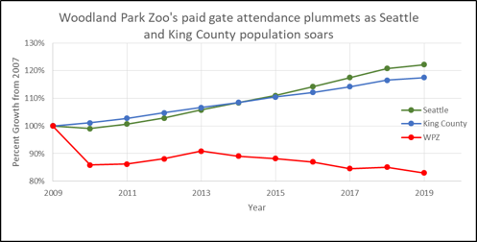
In Seattle, WA, Friends of Woodland Park Zoo Elephants’ (Friends) effort to retire Bamboo, Chai and Watoto, to PAWS sanctuary in CA spanned over a decade. In that time, we helped the public become aware that it is inhumane to cage elephants who are highly intelligent and far-ranging. We believe this allowed people to extend their awareness to include other wild animals. We base that on the fact that paid gate attendance to Woodland Park Zoo has steadily declined for well over a decade. People are getting it!
This graph shows that the 10-year trend is unmistakable and accelerating; people are not paying to go to Woodland Park Zoo in the numbers they used to. In fact, the 2019 paid gate attendance was at the 2004 level despite the population boom in the Seattle/Puget Sound region over the past 15 years. The downward trend is especially precipitous during the last several years. Zoo Memberships have also not kept up with the population boom. This decline included many of the years when the elephants were still in Seattle.
We believe the reason for this downward trend is that the public’s attitudes are changing. This was found to be true in a 2017 survey commissioned by Friends and conducted by GMA Research, a respected national polling company.
Here are two very revealing survey findings:
85% of respondents believe that people are changing the way they think about keeping wild animals in captivity.
Only 1% of respondents said they learned about wild animals by going to the zoo even though the zoo was offered as a choice.
The captivity industry did their own research in 2014. The World Association of Zoos and Aquariums found that actions people would take to protect wild animals and their habitat significantly DECREASED after a zoo visit. In other words, the captivity industry debunked their own time-worn claim that seeing a wild animal in a zoo results in people caring and taking action to advance conservation. It does not.
So there you have it. A visit to a zoo is not about conservation and education but it is primarily for entertainment — on the backs of suffering wild animals.
We know that elephants and all the other wild animals in a zoo retain their wild instincts. It takes generations of selective breeding to domesticate an animal and that’s not what zoos do. This means that everything that is important to a wild animal’s life is denied to them. Caged animals cannot engage in some of the most natural behaviors such as courting, mating, hunting, foraging, digging, burrowing, rubbing up against a tree, running and perhaps the worst of all is that they cannot flee. Caged in a zoo, wild animals suffer physically and psychologically.
Friends had a lot of help which is essential for success. The Seattle Times, for which we were incredibly grateful, did a lot of heavy lifting with seventeen editorials railing against the zoo, writing opinions like, “The business of breeding elephants, displaying them and exploiting them as revenue drivers should end.” Many other media outlets covered Friends’ efforts which helped to spread awareness.
Friends’ left no stone unturned in making the public aware of the plight of the elephants. It used social media, aerial and bus advertising, letter writing (including to zoo donors), calling, banner drops, demonstrating at the zoo and city hall, leafletting, and speaking on TV and radio. We held press conferences and met with the decision makers. All these efforts worked toward making people aware of the suffering taking place right in their own back yard.
All throughout Friends’ campaign, we offered an alternative to the elephants leaving Seattle. In other words, we offered a solution to the void of taking something away. We, along with one Seattle City Councilmember, suggested using technology as the humane way to champion education and the conservation of wildlife. We promoted virtual connection as a way for people to immerse themselves in the lives of wild animals where they live; their triumphs and struggles. This would be a way for people to learn how animals raise their young, how they outwit competitors, how they avoid their enemies and how they play their vital role in keeping the ecosystem healthy. Technology can open worlds utterly beyond the potential of any traditional zoo—and without any of the suffering.
The outcome of our campaign was a tragedy for Bamboo and Chai. Woodland Park Zoo’s management prevailed in sending them to another zoo. But we can claim some success in that the zoo’s goal of becoming an elephant breeding center ended (Chai was artificially inseminated 112 times) with the closure of the elephant exhibit. The long term effects of the negative publicity and the spotlight on how harmful zoo life is for elephants and other wild animals has clearly had an effect. People are voting with their feet and not going to the zoo in the numbers they had in the past.
_________________________
Alyne Fortgang is Co-founder of Friends of Woodland Park Zoo and led the decade-long effort to retire Bamboo, Chai, and Watoto to PAWS sanctuary in California.