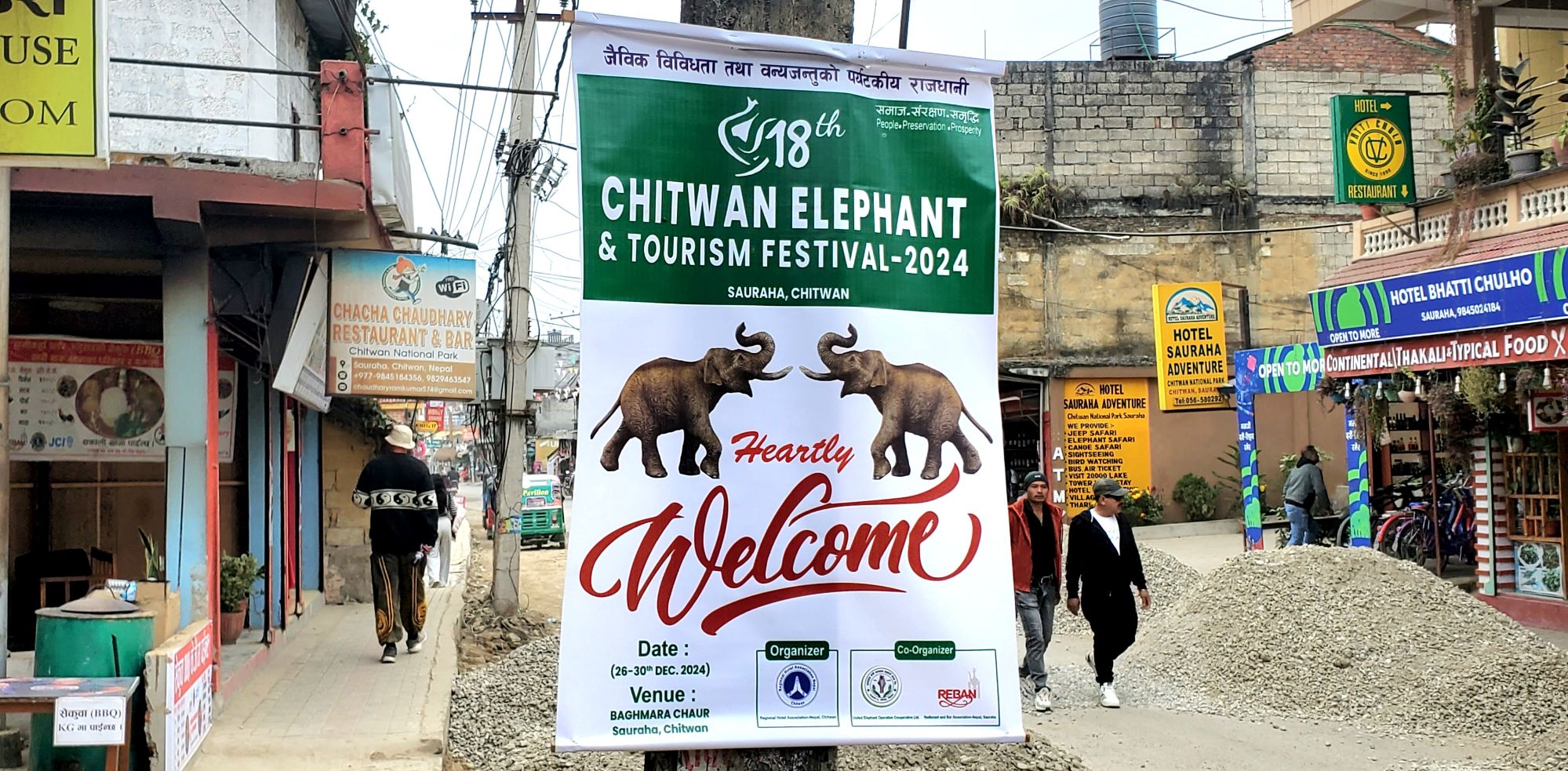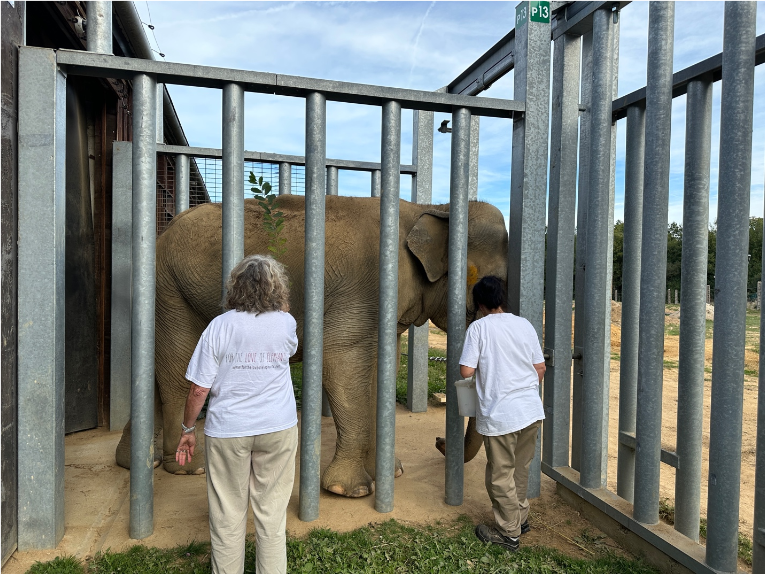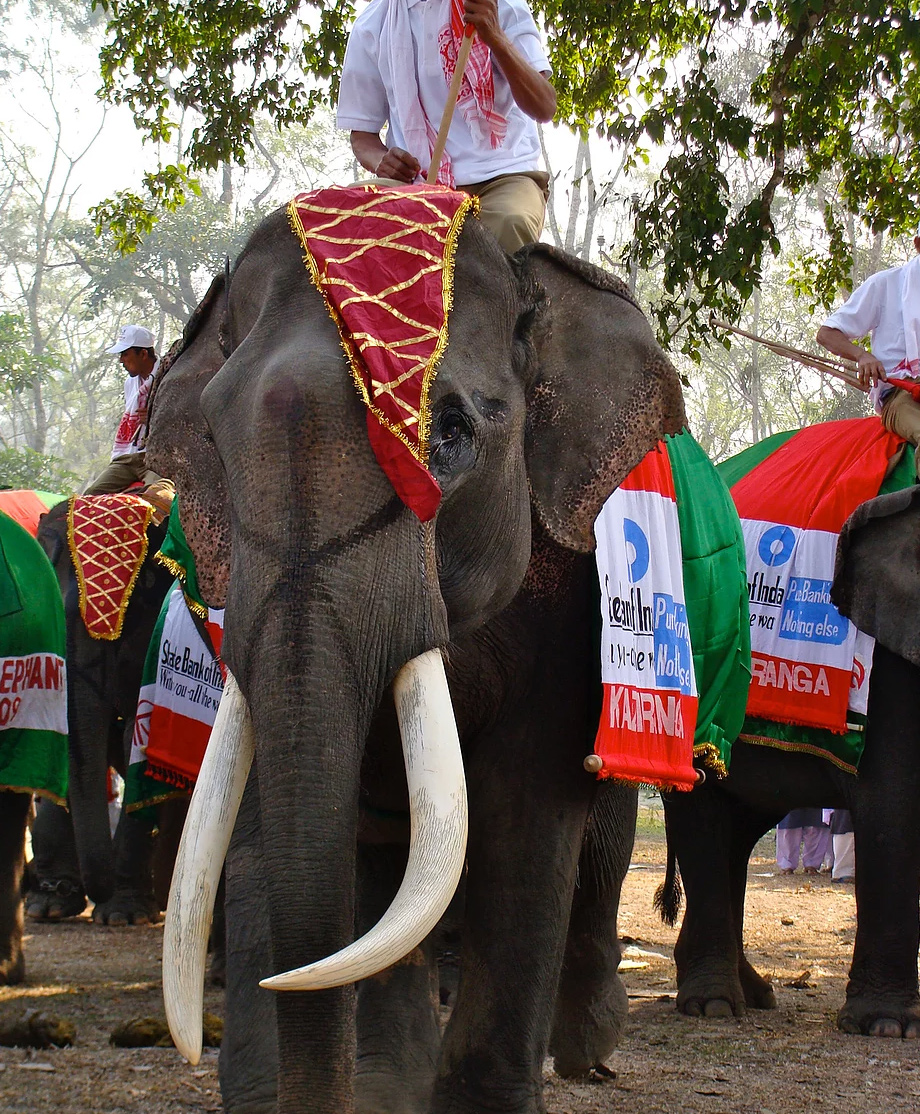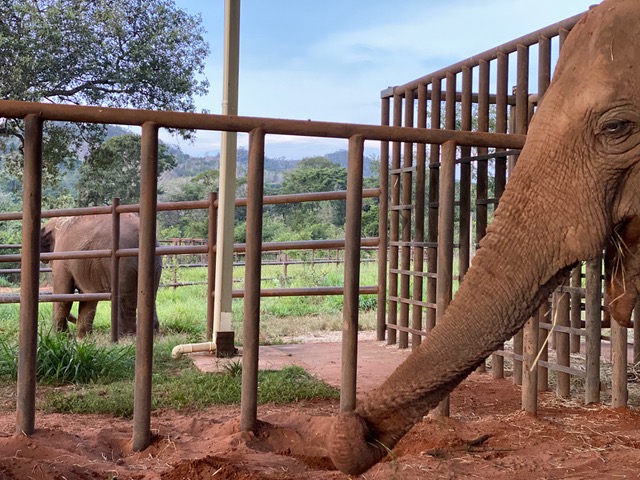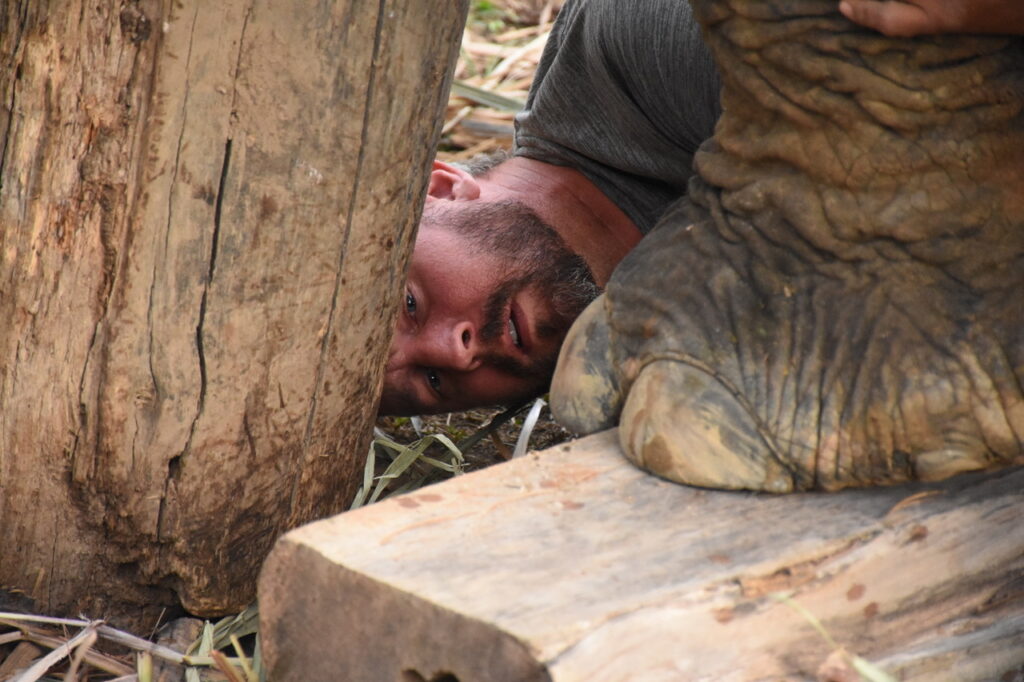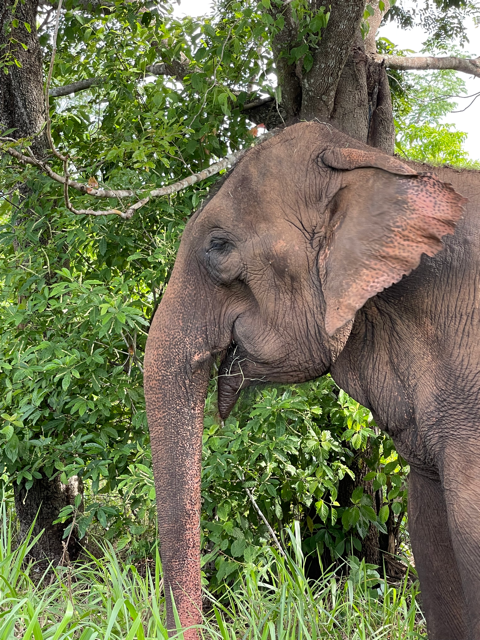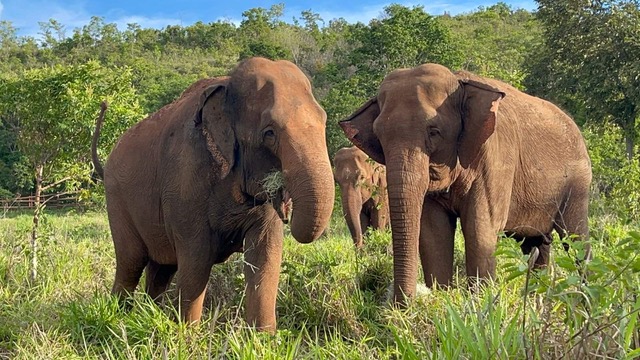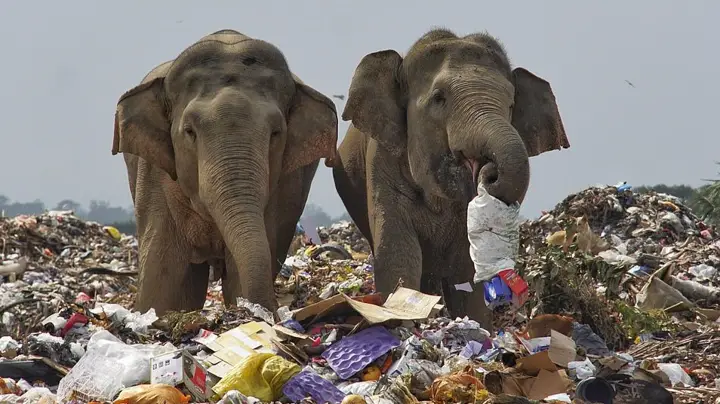
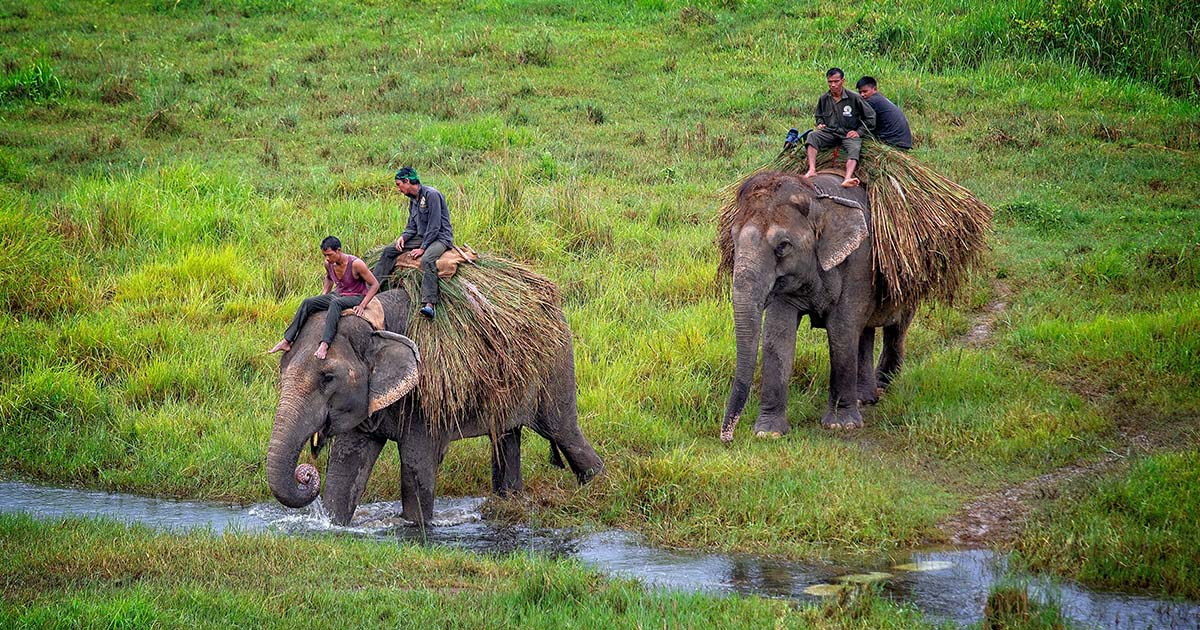
In December 2018, the elephants encouraged me to write about the 15th Elephant Festival in Sauraha, Nepal, a village bordering Chitwan National Park, which you can read here.
Six years later the elephants are still forced to participate in this festival.
Elephants Forced To Play Football – Nepal Elephant Festival December 27, 2024 Sauraha Nepal
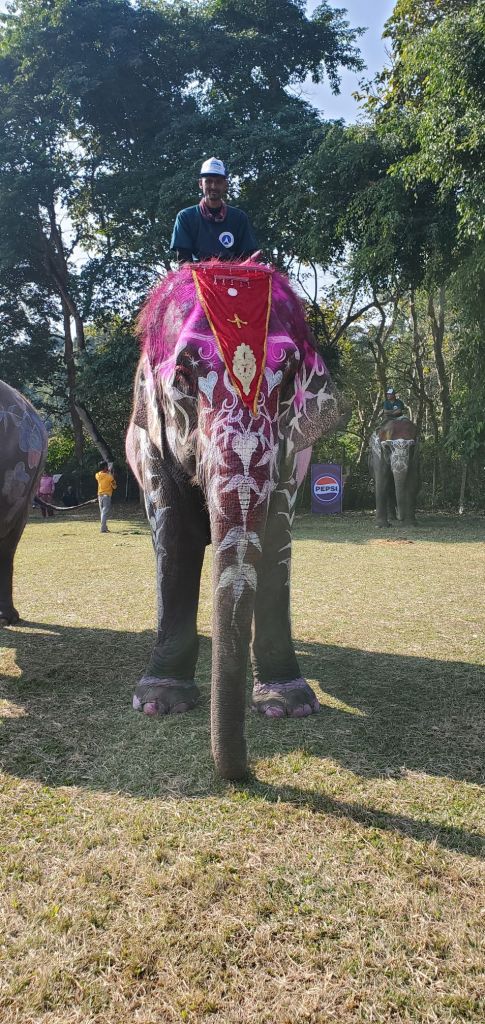
Painted, Chalked, And Glittered Elephant Forced To Participate In The Beauty Contest – Nepal Elephant Festival December 27, 2024 Sauraha Nepal
Celebrating Tharu Culture – Nepal Elephant Festival December 27, 2024 Sauraha Nepal
The local community sets up stalls around the perimeter of the festival selling alcohol, cars, cleaning supplies, crafts, food, honey, internet, jewelry, and toys to earn much needed rupees.
The elephants shared they would love a different type of festival. An elephant festival where they do not have to participate in the physical. Their suggestion is for humans to hold relay races and human games highlighting the indigenous communities culture.
There are humans who may not understand why the elephants would not want to participate in the festivals elephant picnic. Elephants are decorated with body chalk, lined up on the festival grounds and forced to eat foods brought in for them. The elephants simply state that they would rather do other things.
Makuna, a wild elephant decided to attend the last day of the festival. Frightened festival attenders were seen running away. Perhaps if humans like John Abrahams cannot convince the Nepal Government to change the festival maybe the wild elephants will.
ElephantVoices.org shares that the Amboseli elephant population is a cross-border population inhabiting both Kenya and Tanzania. The ecosystem includes Amboseli National Park and the surrounding conservancies and lands in Kenya (~8,000 km2) and the Enduimet Wildlife Management Area and beyond in Tanzania. There are currently ~2,000 elephants using this ecosystem. For 51 years these elephants have been closely studied by the Amboseli Elephant Research Project (AERP). It is the longest, continuously running study of elephants in the world and one of the longest studies of any animal in the world.
Each elephant is known individually and has a code number or name and is documented photographically. Birth dates for all but a few of the older individuals are known as well as the mother and the family and, in some cases, the father. A detailed database contains every elephant identified over five decades, including births and deaths and numbers over 4,000 individuals. A linked database houses every recorded sighting. The Amboseli data is an extraordinarily rich and important body of knowledge. Each individual, each record is a building block that underpins this immense scientific achievement gained over the past half a century. Indeed, much of what we now know about elephant behavior, communication, social structure, demography, reproduction and genetics, has resulted from this study.
There are 63 elephant families in the Amboseli population of which 17 families, consisting of 365 members, regularly spend time in Tanzania. In addition, approximately 30 adult male elephants, over the age of 25 years, use the Enduimet area and beyond in Tanzania as part of their home range. For half a century Enduimet has been a favourite area for a particular set of adult males who make use of it as part of their “bull area”, which is an area they use when they are bulking up for their next reproductively active period. When they are active they return to central Amboseli in search of mates.
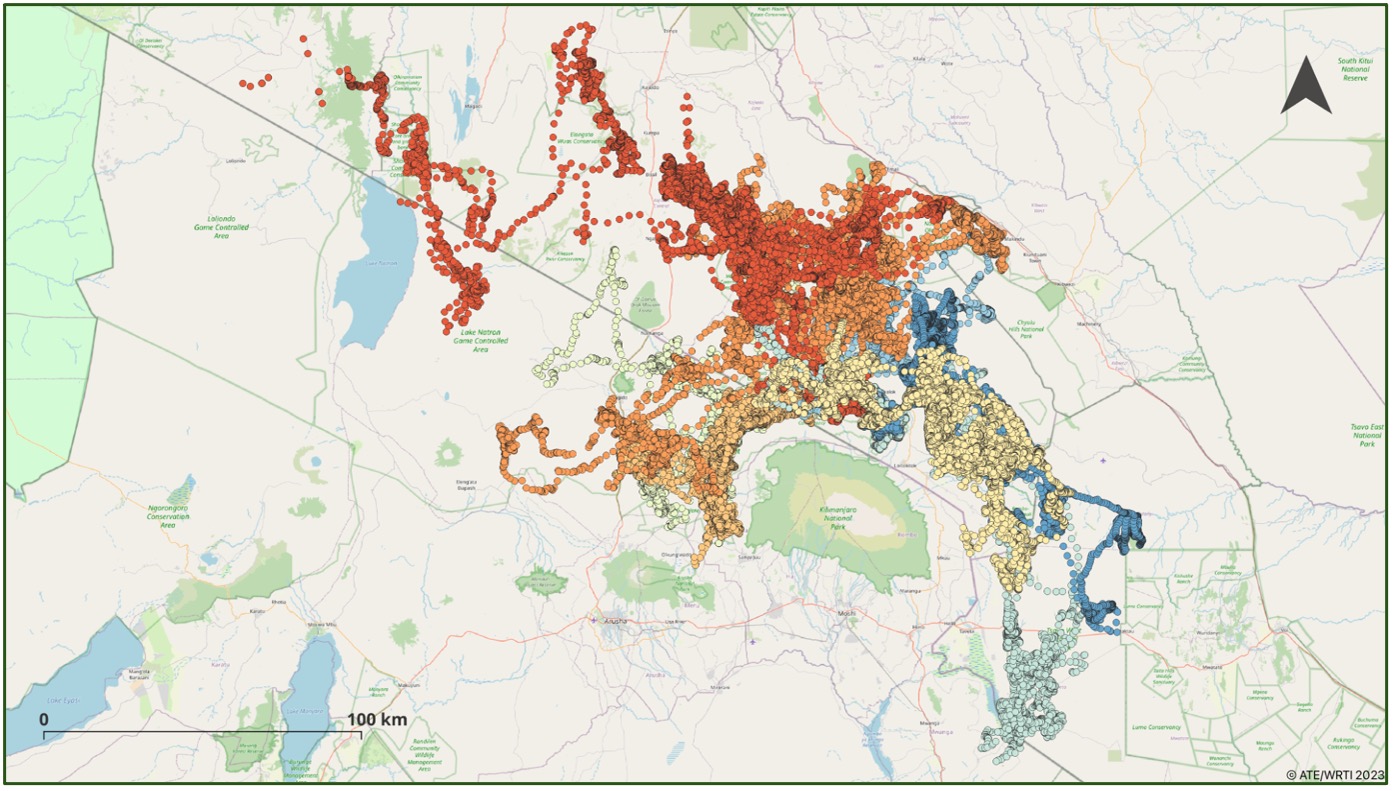
Satellite tracking by Iain Douglas Hamilton in 1995-98, as well as extensive tracking of more than 30 individuals by Alfred Kikoti based in Tanzania, and more recent tracking by AERP reveals that elephants regularly move back and forth across the border and south into Tanzania, including in some cases across to Lake Natron. The map shown below, illustrates AERP’s recent (2019 to present) tracking results of eight young males from known Amboseli families. It is reasonable to assume that any elephant found in this area of Tanzania is part of the cross-border population and has been captured by AERP’s long-term study.
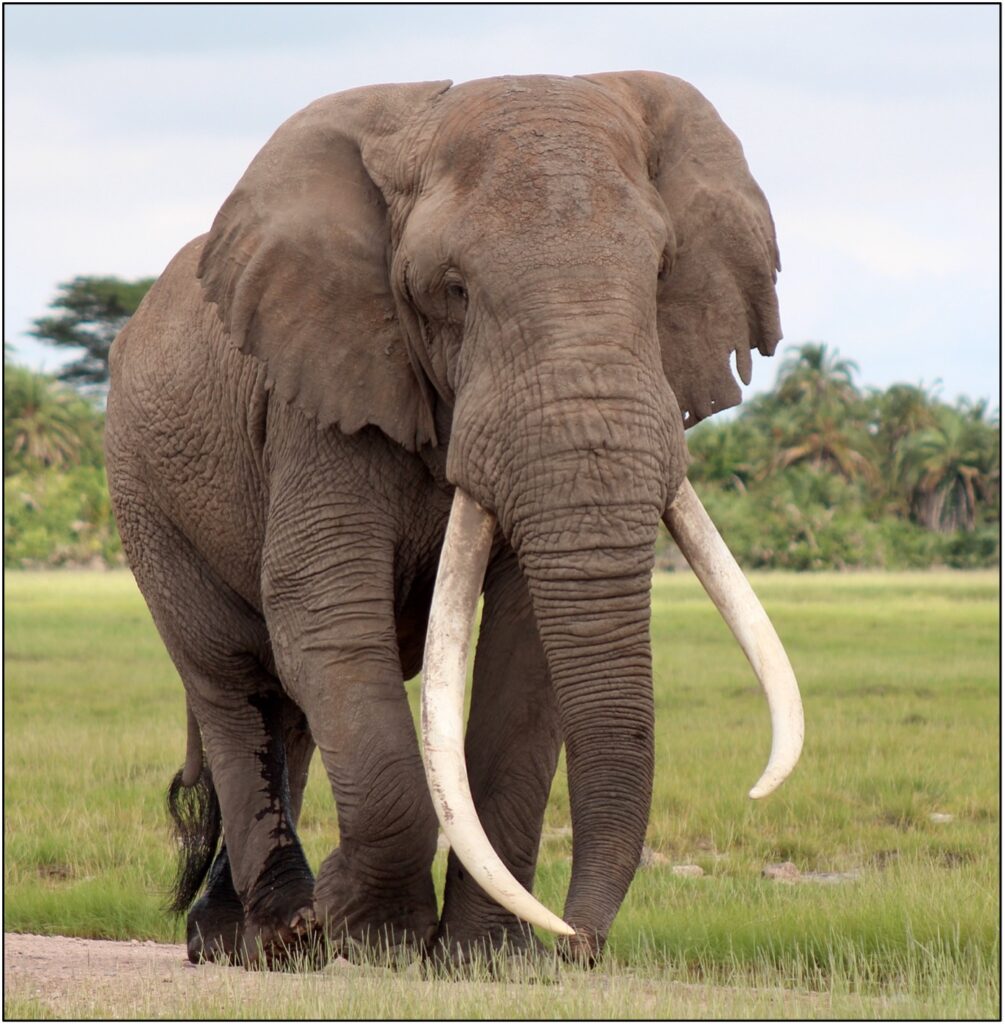
The Amboseli population includes adult males with some of the largest tusks on the continent due to the particular genetic makeup of these elephants (the largest tusks ever collected and displayed in the British Museum come from this population) and to the years of protection from trophy hunting and poaching they have been afforded.
Male elephants grow throughout their lifetime, as do their tusks. The males with large tusks that are targeted by trophy hunters are the older males in the population and the primary breeders in elephant society. Far from being “dead wood,” males who live to an old age produce a disproportionate number of offspring. Older, larger males are dominant to younger males, have longer musth (sexually active) periods and are preferred by females. By selecting older individuals, hunters not only have a damaging effect on elephant lives and society, but are negatively influencing the genetic future of the Amboseli population, not to mention the ecosystem’s tourism potential.
Our position is that the Amboseli cross-border population should be protected from trophy hunting because it is unique and highly valuable as a scientific base of knowledge of elephants. In addition, it represents one of the last gene pools for large tusks. A successful moratorium held for 30 years. Surely, conservation alternatives can be found to conserve in perpetuity this cross-border population that should be viewed as a World Heritage. We appeal to the Tanzanian and Kenyan governments to work together to protect this cross-border population, to recognize its immense scientific value and to ensure that these treasured elephants are not the target of trophy hunters.
The hunting of these individuals undermines conservation efforts, disrupts the social structure of elephant communities, and poses a significant threat to the future of this population.
We implore you to recognize the scientific, ecological, and economic value of the Amboseli elephants and to grant permanent protection to these icons of Africa in the cross-border area that is part of their regular range.
ElephantTrust.org shares that the ATE team has identified one of the males who was recently shot by sport hunters in Tanzania. He was 35 year old Gilgil, the son of Golda, matriarch of the GB family. His father was the magnificent Dionysus. He was the first of three elephants killed – Gilgil in September, another in November, and a third more recently. We have been informed that three more hunting permits have been issued.
Urge the Tanzanian Government to Reinstate Cross-Border Wildlife Protection Agreement
We urge the Tanzanian government to take immediate action by reinstating this critical cross-border agreement with Kenya. This move will demonstrate Tanzania’s commitment towards preserving global biodiversity and ensuring that future generations can appreciate the beauty and importance of these magnificent creatures.
We are Maasai elders from Northern Tanzania. Any day now tens of thousands of our community could be forced off our ancestral lands to make way for elite tourism, trophy hunting and carbon trading. We urgently need your support.
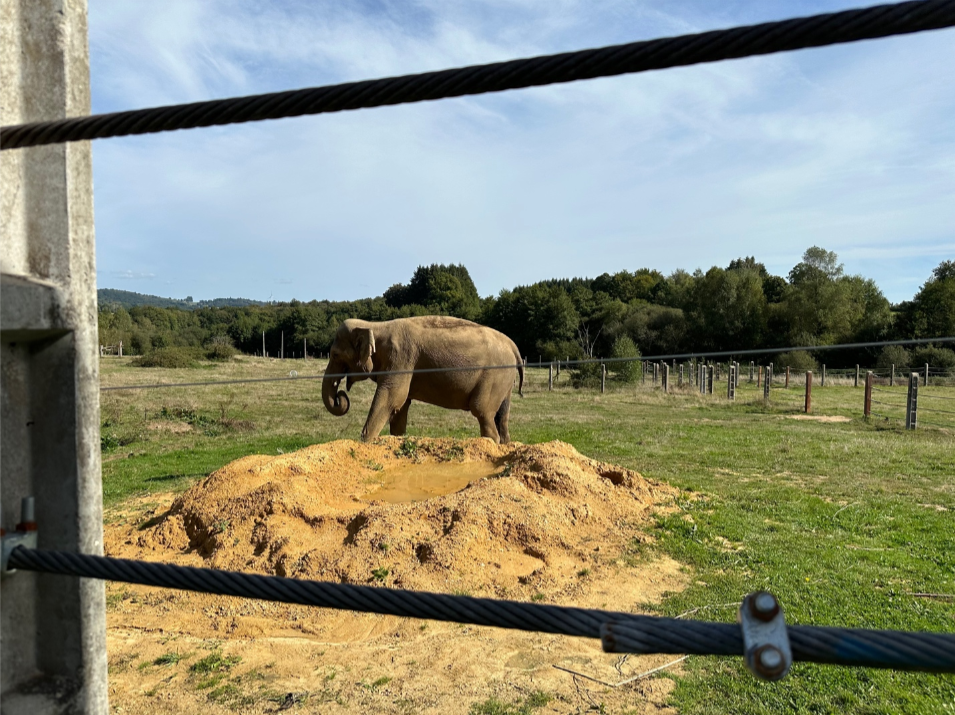
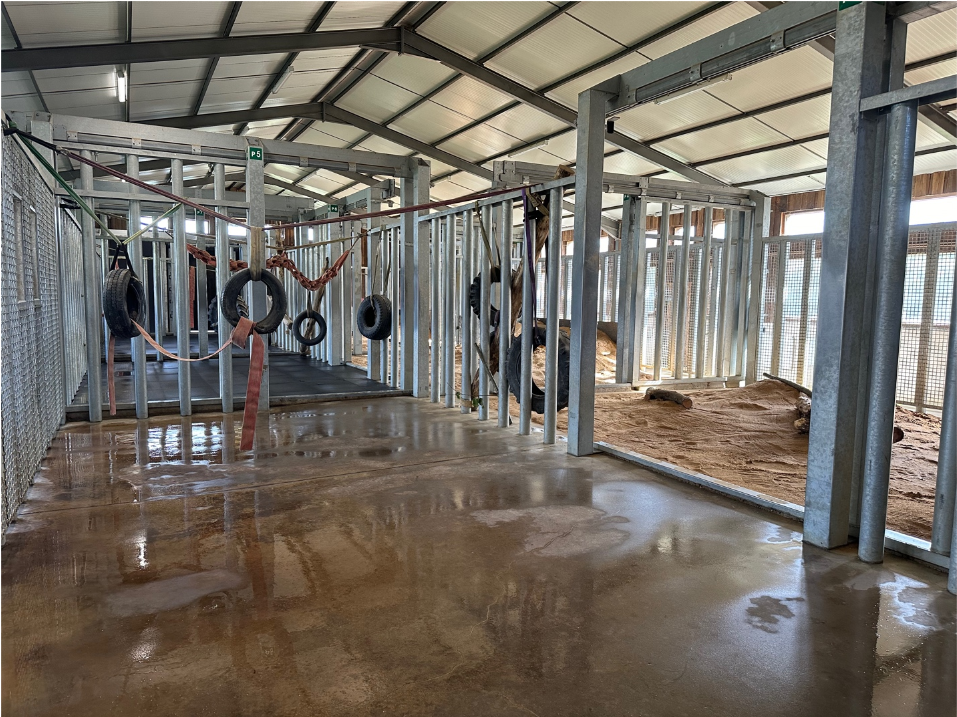
Nestled in a beautiful pastoral landscape is Europe’s First Elephant Sanctuary, Elephant Haven. I have been very excited to visit this place knowing many elephants live in captivity in various states of the EU. Practicing body therapy for all species (human and non-human) for over 25 years, my special dedication has been elephants. Confinement to a life in zoos, circuses and other entertainment venues has caused these highly intelligent mammals physical, mental and emotional stress. My work has brought me to countries in Africa and Asia where both species experience substantial harm to their well-being. Thankfully, increased awareness and activism over the years have led to the establishment of Elephant Sanctuaries. Yet, the word “sanctuary” has been often misused, so one needs to carefully look to ensure it refers only to an ethical place – with an absolute dedication to the NEEDS of an elephant and not the desire of people to touch, bath or ride them.
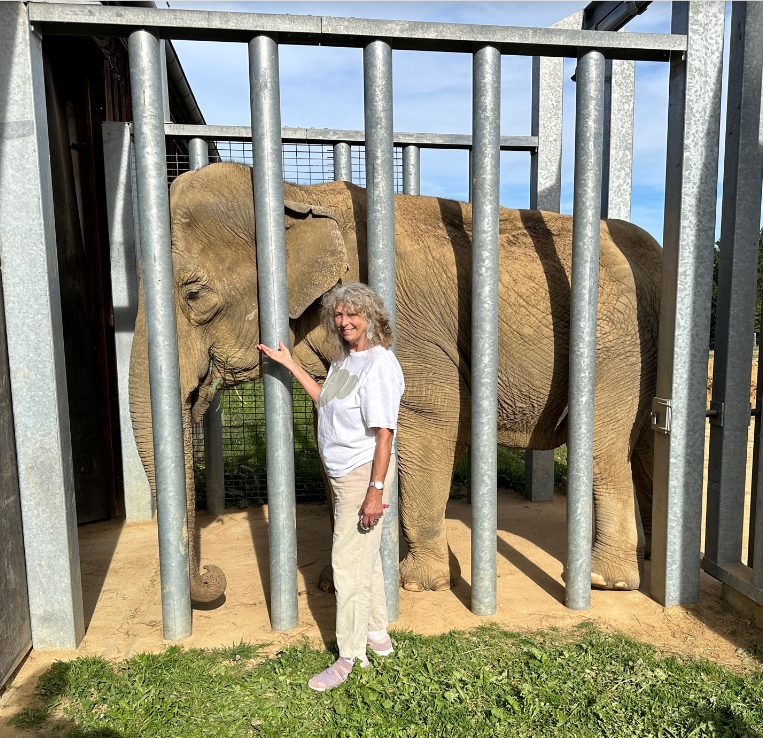
Toni and Sofie are just that kind of people who want to provide the two resident elephants in their care – Gandhi and Delhi – with the very best. Meeting these two elephant ladies was the highlight of my trip to Europe. I followed the Elephant Haven facebook page regularly to familiarize myself with this exciting project of manifesting a peaceful and compassionate place for European elephants to be sent to for retirement. Observing Gandhi for a while next to a big pile of beautiful, elephant-loved dirt while chatting with Sofi warmed me up to the hands-on healing work that I am devoted to share with caretakers wherever I go. Our bodies, human & animals alike, hold memories of neglect, abuse, and torture of any kind in the vast terrain of our emotional, mental and physical being. Body-centered modalities like “TTouch” are wonderful, gentle ways to be calming, building trust, and allows the body to
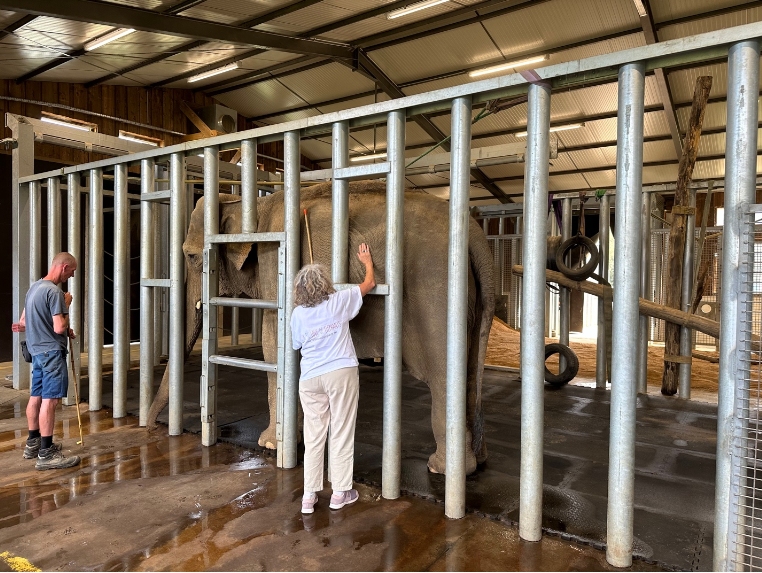
restore itself on a cellular level. We decided first for Delhi to be introduced to my work. In the spacious barn she received treats of apples, carrots & veggies as I approached the protected barrier. Sensing her personality I asked Toni to position her so that I could touch her. Kindly positioning an elephant is part of husbandry training that all captive elephants go through in order for their body to be inspected of anything concerning health and in particular, for foot care.
Unnatural living conditions can cause often great damage to the toenails and foot pads. As I put both of my hands on Delhi, feeling her wrinkly skin, I was sensing a lack of groundedness. I paused a long moment, before I made soft, mindful circles, inch by inch, toward her tail. It was there near the buttocks she moved slightly away telling me that she was not sure accepting being touched on the area, holding presumably on to some internalized fear. I slowly stepped away and got myself a pole to use as a neutral tool to stroke her at the area. It went momentarily better but she needed more time to learn that I was not going to harm her. I learned from Sofie that where she came from in Asia sadly her tail hair got pulled out to make bracelets. Toni threw her treats again and asked her to turn and put her back foot on the bar so that I could demonstrate the TTouch on this important part of her body. This went very well and Delhi showed me the signs of relaxation that I particularly pay attention to. She started slowing down on eating and then stopped chewing completely, an indication that she was feeling comforting sensations. That is when deeper relaxation takes place, and stimulates the release of the brain chemical Oxytocin, also called love hormone. Mindful touch, positive physical interaction, facilitates wellness in all species and can be a bonding experience.
Elephants are very tactile creatures, as can be seen on the many touching wildlife documentaries that are available in the media. Gandhi was next to be tended to. We went outside next to the barn where a suitable place was provided to introduce myself to her. This elephant lady was easier to approach with Sofie standing next to me feeding her treats while I used gentle TTouches on her face and then her torso. Gandhi was the first resident and therefore has been settling into her new home longer. You can read about the detailed history of both elephants on the sanctuary website. Gandhi was nicely receptive as I kept addressing her body, very sweet. As with many other elephants I wanted to show massaging the tongue and we moved inside the barn for this. I usually like to use a piece of banana for pleasing the tongue through a unique combination of massage highlighted by taste. In my experience, this is much loved by most elephants.
Saying good-bye filled my heart and soul knowing that these elephants are in very good hands and hopefully many more of these magnificent mammals eventually find their way to this sanctuary.
Videos of my interviews with the founders of EHEES — Part 1, Part 2.
Leaving her office this September in the Bandra district of Mumbai, India, Ramya Rao was shocked to see an elephant participating in the Ganesh Chaturthi festival going on. Upon closer inspection Ramya realized the elephant is robotic. “I danced with joy literally! So real looking! Can we only have robotic elephants for all festivities and ban using real ones?” said Ramya.
The life-like elephant, named Irinjadappilly Raman, was built by four young artisans from Thrissur, a district in Kerala India for Rs 5 lakhs. The mechanical elephant was inducted by the Irinjadappilly Sree Krishna Temple in Kerala. This was the first time a Kerala temple has used a mechanical elephant for its festival.
PETA India, People for the Ethical Treatment of Animals, donated the mechanical elephant to the temple who welcomed the robot in a traditional ceremony called ‘Nadayiruthal’ in which offerings are dedicated to the deity.
“The elephant figure has a height of 10.8 feet and with the wheels, around 11 feet tall. The core structure is made using steel and the outer material is rubber to give it a life-like feel. It weighs around 800 kgs and took us two months to complete,” said Prasanth Prakasan, the co-founder of Chalakkuduy-based Four He Arts, which created the elephant. The robotic elephant can move its head, eyes, ears, mouth, tail and trunk like a real elephant.
Live elephants are widely used in religious festivities in Asia. The elephants are dressed in heavy cloth and jewellery, oftentimes covering their heads and ears. Some elephants are hobbled in chains forced to walk in large crowds of people who are shouting or chanting, fireworks are often going off above their heads, drums beating. Noisy atmospheres in unbearable heat with a handler nearby ready to beat or stab any elephant showing signs of wanting to get away.
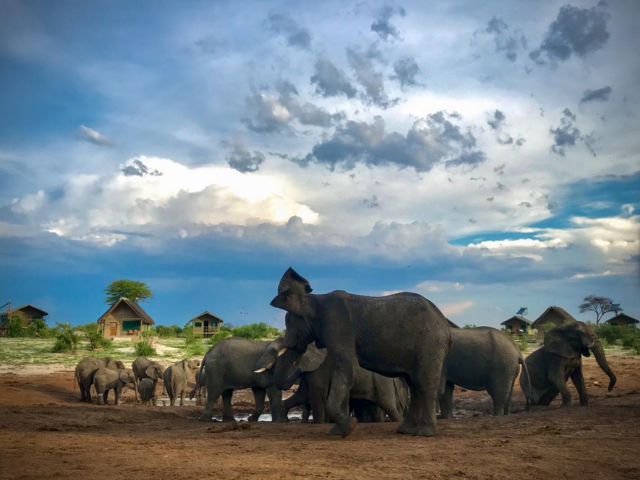
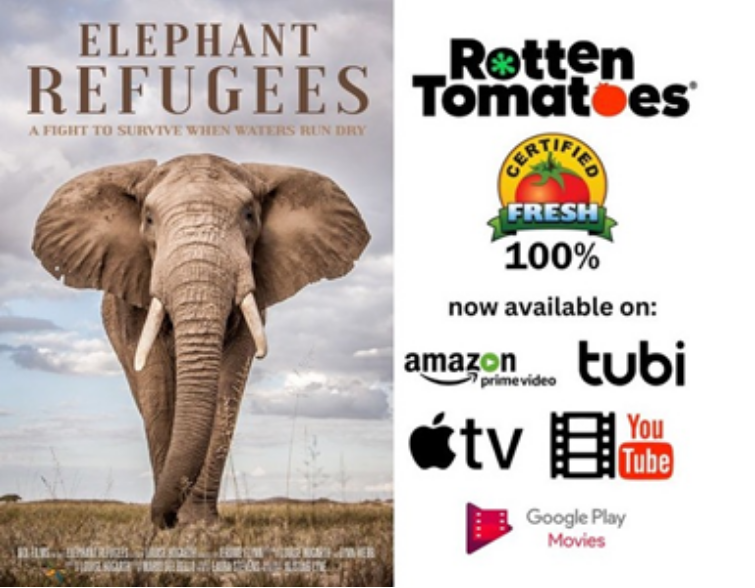
Elephant Sands is a modest lodge in Botswana which was started by Marie and Ben Moller out of their love for elephants. Tragically, Marie suddenly passed away a few months ago. Ben’s daughter and son-in-law do much of the heavy lifting now. Their story has been made into a must-see documentary titled Elephant Refugees. It is available on several streaming services including YouTube and TUBI for free without commercials. If you don’t have any of the streaming services, you can watch it for free on YouTube but with commercials. It received a rare, and well deserved, 100% on Rotten Tomatoes.
Botswana had become a sanctuary for elephants due to its ban on hunting. The elephants would pour in from all the surrounding countries. Botswana has the highest population of elephants of any country in the world. Elephants knew they could safely travel to Elephant Sands to find water. They came from far and wide to survive—especially during times of drought.
All the water is trucked in to Elephant Sands three times a day by a double tanker. The road is sand and can’t support the weight of their tanker truck, so the Mollers built an 8.5 mile pipeline. Three Solar pumps in three locations outside of Elephant Sands are used to pump water 8 hours a day. If they had a more powerful pump that could work 24 hours a day, they could provide water for about 2,500 elephants instead of 800. When water is scarce, the elephants come first and the swimming pool for tourists at the lodge is emptied. Botswana being a safe haven for elephants all changed in 2019 when a new president was elected and he lifted the ban on hunting elephants. About 2.5 million acres surrounding Elephant Sands is now a year-round killing field. The government cited lifting the ban on killing elephants due to overpopulation of elephants, human-elephant conflict, destruction of crops, and the millions of dollars permits could raise for the country.
The elephants still come looking for water. But now they are aggravated and traumatized by seeing their kin being killed. Elephant Sands is not in the delta region where most tourists go to the swanky lodges, but in Nata, in the middle of nowhere. Booking tourists is critical to being able to afford water but you can help without making the trek to Nata.
The Moller family does so much with so little. Will you help them afford a more powerful pump? You can donate through Elephant Refugees filmmaker’s website to get the U.S. tax deduction. (Please designate that your donation is for Elephant Sands). The filmmaker can also be reached via Facebook.
If you choose to contribute directly to Elephant Sands, you may write to them by email for the bank details for WATER FOR ELEPHANTS TRUST.
As a consultant with Global Sanctuary for Elephants in Brazil, I spend a couple of months a year there. I also helped with the last 4 transports to the sanctuary. In addition, when I am not there I consult remotely with Kat and Scott almost daily about other vet cases as they come up at the sanctuary. I first came to GSE with Lady in Nov 2019, meeting her at a zoo on the east coast of Brazil and then traveling 5 days together across Brazil to the sanctuary. It was pretty amazing to take the journey and travel the road to the sanctuary as Lady saw it for the first time.
Words can’t describe the magic of the sanctuary. The land in Brazil is so quiet and secluded with macaws flying overhead and amazing sunrises and sunsets and a sky full of stars on clear nights. Lady walked right into the container without any problems. Little did I know how difficult each additional transport would be. In comparison, in September 2020, Bambi was only a three day journey away from the sanctuary but getting her into the transport container was much more difficult than Lady.
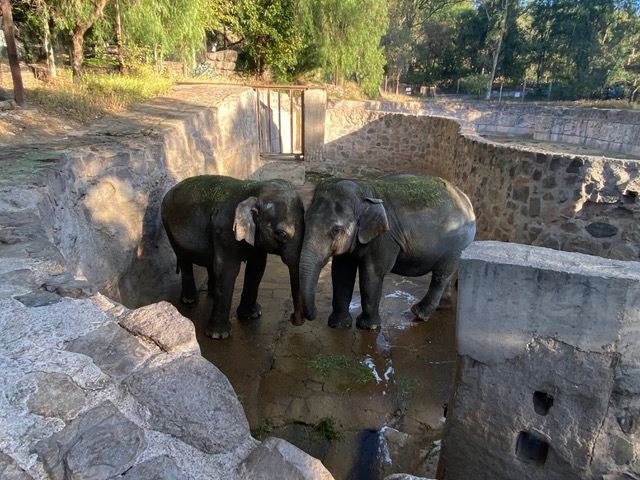
Last morning at the Ecoparque — Pocha on left, Guillermina on the right
I first met Pocha and Guillermina – a mother-daughter pair, in August of 2021. After a mandatory 10 days in quarantine in Argentina, we had 10 days to get them in their crates loaded and across the border into Brazil before the CITES permits expired. Shortly after arriving at the Ecoparque in Mendoza, it became apparent the girls were not used to going in the crates and so we knew we were up against a big hurdle. First, we moved the crates so they were back to back instead of in two different areas of their enclosure. Pocha quickly started coming in all the way to the front and Guillermina would come in with two feet into the second one. So we went for closing Pocha in and hoping Guillermina would face her fears and run after her mom but we were wrong. We waited all night and tried moving Pocha’s crate a little bit but Guillermina was not ready to leave. As we could not move Pocha without her daughter, we decided to stay and keep trying to get the girls comfortable In the crates while we waited for CITES permits to be renewed hoping it would take 4-6 weeks to get the new permits.
Watching and listening to the two of them being reunited that night after being separated by gates for only a couple hours really hit me hard because that is how every elephant in captivity must have felt when they were taken from their mothers. Luckily, Guillermina will never be taken away from her mother. About a month after we first tried, on her own Guillermina started backing all the way in surprising us all and Pocha started following her in. We kept waiting for CITES permits and eventually a petition had to be started to convince the Argentina government to approve the move of the girls. I left them in October to return to my two elephants in Nepal hoping I would be coming back to move mom and daughter soon. It was very hard to leave knowing these two were still stuck in their concrete dungeon. But as one supporter said freedom delayed is not freedom denied and this kept me going during the next 7 months.
I was visiting GSE in April when we got the sudden news that the permits had been issued. Within a week of issue the team had assembled in Mendoza and the girls were still hanging out in their transport crates, now more comfortable and ready to move. We were all still nervous if we could indeed close both elephants in their individual crates. Closing the girls in their separate crates went amazingly well. I think they were both ready to go. We loaded Pocha on first to go backwards and then Guillermina second to ride going forward facing her mom.
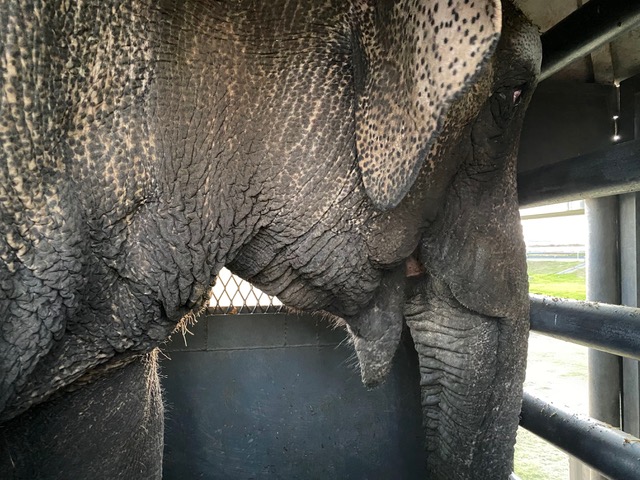
Pocha in her container on the road at a rest stop
I find the first 24-48 hours with all the girls can induce motion sickness. Guillermina started out eating really well. Pocha was very picky but then they switched as the long 5 day journey went on. Guillermina became more anxious and was eating less and Pocha settled into the groove of the road trip and became more affectionate, opening her mouth and showing her tongue which she does when she wants attention. Days on the road are long, trying to leave at sunrise and usually driving till 11 pm or even 1 am. We do stop every 3-4 hours to refresh food and water for people and elephants, but the longer we stop the longer the journey will take. So we are always trying to find the right balance of getting the miles in but also watching to see what the girls need as the elephants can rest deeply only when we stop. After the caravan stops the girls still have to be fed and offered water but usually they were exhausted themselves and ready for bed. As the vet in charge of the elephants we travel with a 50 lb emergency bag of drugs and IV fluids, everything and anything we might possibly need if we had an emergency anywhere along the road, which is often not near any town. It is a bit nerve wracking to have such precious cargo under your care. Luckily all 4 elephants I have transported to GSE have all done well and not required any medical interventions but we are ready to treat any abdominal pain/colic, pain, allergic reaction, dehydration, etc. We use essential oils around the containers to help with the transition and journey and the elephants get flower essences to help them deal with the emotions and I do think these two modalities help make a big difference. I like to get the girls different sweet treats at the truck stops: cookies, dried fruit, juices, fruit popsicles, etc. just to keep them excited. We also use ginger candies for motion sickness. Scott is in charge of all the logistics and my priority is to make sure the elephants are remaining as calm as they can be and physically mentally doing well as we move the containers from the ground to the trucks and on the road.
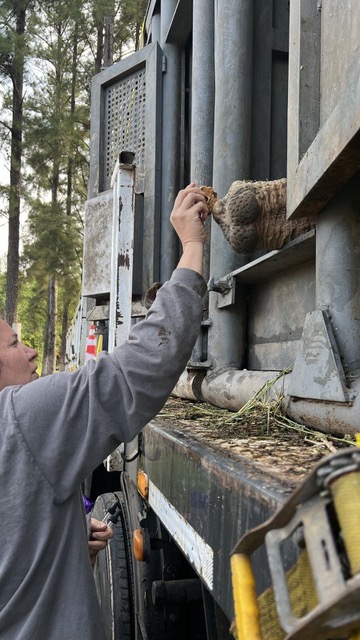
Pocha reaching out to grab cookies and flower essences at a food-water break
When moving Lady and Bambi we had two cars following the elephant truck and police escorts in front.This time with two elephants we had two trucks (one just to carry food and supplies), two police escorts, a van from Ecoparque Mendoza with previous caregivers, and two cars following the girls. At the Brazil border we were met by ESB staff and volunteers, our typical transport crew and so two more cars. We also had 7 photographers in total documenting the journey!
At the border we had to clean both crates thoroughly as possible to not bring anything into Brazil from Argentina. Scott , Ingo and two caregivers from Mendoza and myself stayed up all night cleaning the containers in the dark and the rain but also having a lot of fun, so excited to be at the Brazil border and hopefully just 2 days away from sanctuary! We drove through rural Argentina and Brazil where most people have never even seen an elephant even in a zoo. So when we stop for gas and to give the girls food and water we cause quite a spectacle but it’s a great time to educate people about zoos and the sanctuary in Brazil. And we meet lovely people along the way, some donating food for the people or elephants and even one gas station donating diesel for the trucks!
Talking to and checking on Pocha on the trip
Arriving at the sanctuary we all thought and expected the girls to come running out like Bambi did and I was really surprised how hard it was for both of them to leave the crates. But the crates which 7 months ago had been foreign, had now become home to both. Similar to people too afraid to leave their house, town, or country, it just shows the trauma elephants have been through and how we all process things at different speeds and ways. I thought I would cry when the girls came out of their crates but it took so long for them to leave, I was just too exhausted to feel anything but relief that they were both out and safely delivered.
An unexpected rain storm led to first mud bath at the sanctuary with two feet out of the container
It has been amazing to work at GSE with Scott and Kat and Ingo and the rest of the Elephant Sanctuary Brazil team. We all brainstorm together what to do next watching and listening to the elephants and keep trying new things to help them feel comfortable with their transition to life at the sanctuary. I was with them at the sanctuary for a week and it was so interesting to watch them both get the courage to leave the barn, often they both felt comfortable leaving only when we would all leave and stop staring at them. But we could still watch them on the cameras from the office. It has been amazing to watch their transition these past two months with everyday bringing new firsts — feet on the grass, covered in dirt, grazing on grass themselves, breaking trees, finding the mud wallows and pond and meeting five new friends. I can not wait to get back and see them again and bring more elephants to the sanctuary.
This is a guest post by Steve Koyle of Elephant Care Unchained.
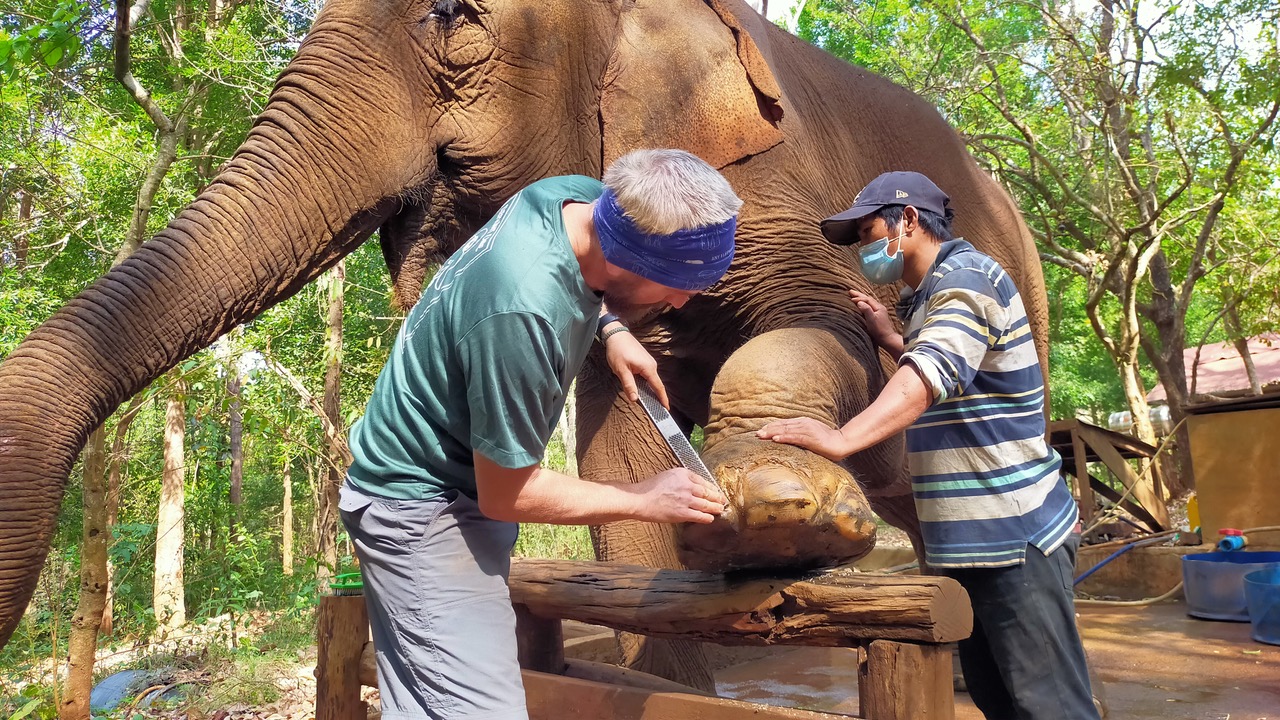
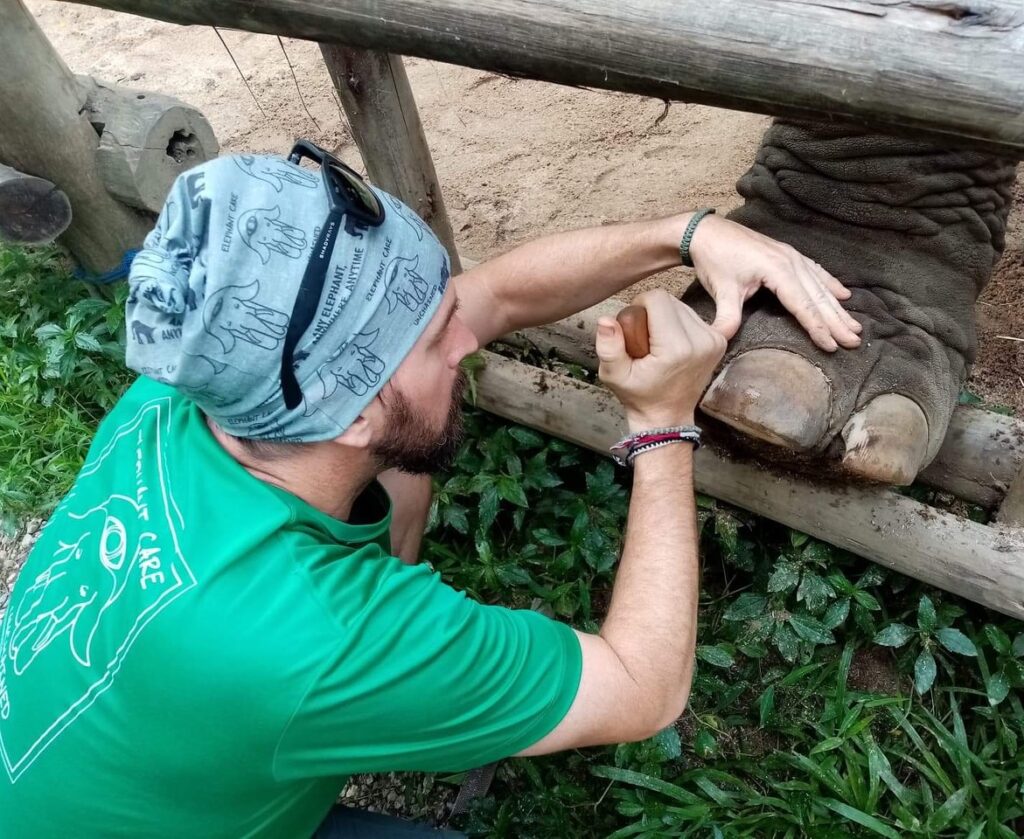
The captive elephant is a tragic story. Throughout my 20 years of caring for elephants I’ve seen and witnessed a lot of pain and suffering. More so since I’ve established Elephant Care Unchained in 2016. Over my 20 years of working for elephants I’ve developed a special skillset that has allowed me to improve the captive elephant life regardless of situation or environment. One skill that I’ve become globally recognized for is footcare. You can tell a lot about the elephant simply by examining the feet. If the elephant has healthy feet, it probably has a healthy environment. Ultimately, the elephants are the easy part, the challenge is the people in charge of caring for them.
Throughout this journey the hardest part is earning peoples trust to gain access to elephants. It’s not an easy task, it’s kind of like a travelling salesman going door to door. In my case, going from elephant camp to temple to zoo to park to try to establish trust with the hope of helping elephants. There are many obstacles to overcome when working in native countries. First is the language barrier. As I travel anywhere in the world to help elephants (currently 6 countries) and try to explain a totally new concept of welfare and compassion is hard enough, especially in a different language. Communicating is
difficult and things get lost in translation. I believe that they think “What does a white guy from the west know about elephants?”
Second is education, most of the mahouts are uneducated and abuse substances. When I explain a “simple” concept either enrichment or substrate that will help improve welfare the message is lost. “If you don’t think anything is wrong then why change it?” For example, elephants’ displaying stereotypic behaviors is just “normal” to most, so in their mind “why change it?”
Third is understanding and working within the culture. Unfortunately, in many cultures elephants are exploited and mistreated under the disguise of culture. How can you help without criticizing the culture? The moment you criticize or insult culture you have no chance of helping. It’s about trying to be more understanding and earning trust. Another cultural obstacle is that, so often us westerners are quick to criticize without really knowing what is going on. This makes helping more difficult since most of the mahouts’ experience with westerners is either to hug and kiss the elephants or publicly criticize their care. Both of which are not helpful to the elephant or their welfare. Understanding the mahout’s situation is another difficult obstacle. Many mahouts are
paid a minimal salary and therefore use the elephant to make money. In doing so, they usually put the elephant into an unnatural and unsafe environment which is very dangerous for them and harmful for the elephant. Elephants do in fact hurt and kill people. So, we must understand that it takes much more than hugs and kisses to care for them.
Lastly, teaching compassion is the extremely difficult. How do you do it? How do you make people care about the elephant as a living being with needs? It’s so emotionally draining to be out here fighting for elephants and improving their welfare. To see people beating and neglecting the elephants makes most days very hard. If only they would apply a few simple suggestions, life would be much easier for everyone involved. The reality is that until elephants’ stop being used as money machines and the cultures change their attitudes toward them. It’s going to be a long road to end the unnecessary suffering. It’s a road that I will forever be on fighting for elephants.
The word Anthropocene has been described as the ‘great acceleration caused by humans‘ originating from the words ‘anthropo’which in Greek translates to human, and ‘cene’ translates to new. In this new era, Earth has undeniably undergone a quickening of degradation with the irreparable extinction of species. This devastating loss of biodiversity has greatly impacted the integrity and symbiosis of the natural environment, most obviously negatively impacting the quality of life for large mammals including humans and elephants. Unfettered capitalism has wreaked havoc on what has naturally evolved through co-existence for a millennia. Elephants are more frequently suffering fates such as death by heat stroke, viruses, parasites, malnutrition, soil and sperm impotency through fossil fueled, monopolized GMOagriculture and industrialized pollution. We are at an unprecedented moment on planet earth when elephants and humans together are struggling form the very same challenges!
Naturally elephants, unlike humans, are not trying to compete in a race for extractive consumption. Elephants, much like natural wildfires, build resiliency across the land — what elephants eat matters, just as what we eat matters! Elephants browse on up to 260 different plant species, 16-18hrs on average per day. This actually paves pathways for wildlife trails, pruning and thinning the forest just as wildfires would. By trampling, weeding out and composting excessive shrubs or trees, they create more water, soil and sunlight availability for trees to grow healthy: stronger, larger, older, sturdier and more resilient. These trees then have a larger capacity to store more carbon dioxide from the atmosphere through photosynthesis in their biomass. Elephants are ecosystem engineers, they are The True Guardians of their native wild habitat providing protection for all species. An elephant’s dung seeds and fertilizes the forest floor, creating a carbon sink storage through soil sequestration, enriching the soil microbes, humus, insects, and small mammals along the way.This natural behavior is essential at some capacity in any natural wilderness, clearing the way for healthy regeneration of naturally occurring biodiversity.
Homo sapiens evolved on the scene around 200,000 years ago, and for 190,000 years we were hunter and gatherers, and over the past 11,000 years we have led a sedentary life thanks to agriculture. It is most evident that in this 11,000 years we have consumed more of the planet’s resources than in 190,000 of evolution. Even more apparent still is in the last 200 years of the Anthropocene we have wrecked things up nearly beyond repair. We must respect nature as our mother, the giver of this life, replenisher of the land and inclusive sustainer for all of her inhabitants.
Elephants are up against hard times in this changing climate: living in smaller ecological habitats and corridors, including their migration areas that are now fragmented and a fraction of what they used to be. Elephant populations are being decimated due to a variety of causes such as poaching, captivity for zoos and circuses, big game hunting, deforestation, environmental degradation, human-elephant conflict, economic development, and unnatural borders drafted for political and religious reasons. Wild elephants are crying out for adequate space to just be an elephant as nature intended to live in union with their matriarchal herd, inhabiting their ancient stomping grounds. Proboscidea, the larger elephant family, began their evolutionary journey in Northern Africa 60 million years ago, surviving basically the same way they are today, sustainably co-existing with all life, reminding one that elephants have never once caused an extinction event.
This Anthropocene is demanding humans make conscious lifestyle choices that are all inclusive, an International Obligation to live more simply, or as Leonardo DaVinci termed simple to be “the ultimate sophistication”. So why reinvent the wheel to heal this Anthropocene when this natural and magnificent healing source — elephants and old growth trees — are already here providing significant services including carbon capture and climactic stability. When we each foster an organic garden and re-wild degraded lands with all the qualities that wilderness naturally encompasses is the moment that elephants and humans will stop being economical and political refugees. An elephant’s vast seasonal migration requires safe all-inclusive wild-flora & fauna corridors, and so do humans.
Elephants are our living, breathing, walking, intelligent, sentient and altruistic ancestral brothers and sisters of earth; their framework and herd dynamism holds ancient symbolism of sustainable safe-guardians of nature. When we release our anthropocentrism or human centeredness and reorganize our framework to value our shared Sacred Earth, spiritually honoring Natural Law and the Rights of Nature, which has so graciously carried us through evolution all together for eons, will ensure our survivability together for eons more.
Working with and, more importantly, for elephants is an extraordinary life, and providing them with the freedoms of sanctuary leaves us at a loss for words to describe the depth of gratitudewe feel. With all of the celebrations of new beginnings that come with a life at sanctuary, witnessing the growth and healing of these sentient beings who have been profoundly damagedin captivity, there is an unspeakable joy in seeing the light return to their eyes; there is an equal,complicated emotion surrounding the difficulties and challenges of running an elephant sanctuary. After 16 years building and developing The Elephant Sanctuary in Tennessee, Ineeded to step away. Kat and I took on a quiet life for a short time, and it too was a glorious life. We looked forward to the ease of stress and constant worry, but I didn’t anticipate theperspective and clarity that came with our return to “normalcy.” When you provide care for suchhighly intelligent and emotional beings, particularly with the complexities of their emotional and physical recovery, they are always in your mind. Not having the constant worry was welcomed and necessary.
Shortly after leaving the Elephant Sanctuary in Tennessee, we received a desperate call to help remove Ramba, the last performing elephant in Chile, from the circus. Two prior attempts to move her had failed and, on the day after Christmas in 2011, the judge for her case set a limit of 10 days and offered one last chance to move Ramba, or she would stay with the circus for the rest of her life. Her relocation was chaotic but successful, and was the first step to her eventual transfer to sanctuary which, at the time, was slated to be the sanctuary in Tennessee. About one year later, with Ramba still residing in her temporary home, and with our renewed perspective on the gifts elephants bestowed on us, conversations for a new venture on our part began.
Some of our colleagues had been working in South America, principally in Brazil, where progressive legislation regarding captive animals was being enacted. No current alternative existed, but they knew sanctuary was the only viable future for an increasing number of soon-to-be-displaced elephants. Almost immediately, we realized they were right, but we honestly hadn’t considered starting a new sanctuary until that point. There is so much to take into account when you go down that road of thought, because you know what challenges almost certainly lie ahead. And, more importantly, we knew the toll it can take on our own lives. Even when you think you know the difficulties you’ll face, so many roadblocks emerge that you don’t anticipate. Long conversations were had in our home about the effort it would require from us, knowing that the next step is not one of “let’s see what happens.” Beginning a sanctuary means you are all in – but, after witnessing some of the things we’d seen in the eyes of elephants we’d cared for in the past, there was an unstoppable pull towards creating a new home for the elephants we’d met here.
When we first arrived in Brazil to start building Elephant Sanctuary Brazil, we were told that land was already available, as was $300,000 in funding, a car, and a place to live. The funding immediately fell through, and the property did the same shortly after. The car was going to be given by the Brazilian government, but was tied to having the organization up and running. No sanctuary meant no car. But the government was still supportive and provided us housing, which wasn’t ideal, but they were making some effort. From our first days in Brazil, zoos asked for advice and prosecutors were inquiring when we could come to relocate elephants in their jurisdiction. Although countless bureaucratic hurdles lay ahead, the situation was unique, where virtually everyone we met, from public authorities to zoos, wanted sanctuary for their elephants. There was a groundswell building around the issue, but no infrastructure in place.
Even with these positive ideas emerging, other significant and often deflating roadblocks continued to pop up. We found tracts of land that may have worked for a sanctuary, but paperwork is different in South America than in the US. Areas that might have been a good fit weren’t documented, the documentation was falsified, or landowners would change their minds and decide not to sell. Brazilian bureaucracy was slow moving and difficult to maneuver, and the entire regulatory body had no idea how to categorize an organization like ours, because we were the first sanctuary of our kind. What little personal funding we had was drying up. At that moment, we looked at each other and pondered, “What are we doing here?” When everything logical said to turn back, with Ramba, Maia, Guida, and many others in desperate need of a new life, it was impossible to walk away. When you know what we know – the level of healing that occurs in a sanctuary setting, the level of transformation that starts from their very first steps onto sanctuary grounds, – there is no turning back once you begin.
We made the difficult decision to alter our original plan. Following an exhaustive search, we fell in love with a property in the municipality of Chapada dos Guimarães, Mato Grosso. The weather in the area was lovely, the land itself was gorgeous, and there was so much about the space that would be stimulating for elephants; of the hundreds of farms we explored, this was one of the most diverse and protected – truly idyllic for sanctuary. Brazilian custom is to pay for land up front, rather than in installments as you might in the US. And, bank loans for non-profit organizations require an individual to fully financially back the loan in the event of default. As we pondered how we could make this work, something just short of a miracle happened: the local landowner was willing to help, based on nothing but good faith and a dream. This man didn’t know of the success of the elephant sanctuary in Tennessee. But he had a big heart, some blind faith and, once he understood what we wanted to do, he wanted to be a part of something that would truly save lives.
There was absolutely no way we could have taken on the task of creating this elephant sanctuary without knowing the significant work that lay ahead. Without our prior knowledge and decades of experience of sanctuary, we would never have pursued moving forward. Our eyes were open and we readied ourselves for the days we knew we’d have to push onward, through almost insurmountable obstacles, but with confidence the project would change lives. We jokingly say that we have just enough faith to continue on when logic says to turn back, but the truth is that we know the difference that genuine, spacious, and autonomous sanctuary brings to the lives of the elephants.
Elephants are beautiful, sentient beings with deep emotions, intelligence, the resilience to endure, and the capacity to heal, and even forgive. This sanctuary is built on the belief that elephants deserve a better life. Captivity, confinement, and isolation for the entertainment of humans has nearly destroyed these precious lives. Sanctuary heals. Freedom gives captive elephants the chance to learn who they really are and what it means to be an elephant. We continue to face challenges, but so has every elephant we meet, to a much greater degree. If they have the courage to forgive, heal, and keep going, then we owe it to them to do the same. It is up to all of us to right the wrongs of the past through our united efforts to make tomorrow a brighter place for all.
Mahatma Gandhi said, “The greatness of a nation and its moral progress can be judged by the way its animals are treated.” No? This rings more true today than ever before with the transparency documented online in the world wide connected web. You see, there is no villain and no hero here as we are speaking about the ‘Elephant in the room‘, a scientifically proven sentient, altruistic and empathic being alone in a barred concrete enclosure in the middle of a loud bustling city. In this evolution of life we all make mistakes. It is a part of learning, but as we learn we compassionately do better for all, understanding that we too are nature, not apart from it. We are here to live the golden rule in this golden hour together ~ “do unto others what you would have them do to you”.
We are at a precipice of change coming together to make things better, for our health, for our home ‘mother earth’ and for each other. This is at the core of our evolution, releasing outdated methods that benefit no one, as is the obvious case of Ely the 41 year old African Elephant who is living an isolated existence halfway across the world from Africa. Living away from her herd where she was born into as a WILD animal, a keystone species, living her days amidst her matrilineal herd who in fact would never spend even a single day or night apart from each other. Ely was designed by God to be an elephant, not a suffering animal displaying to kids the disconnected nature of her tremendous misery. Again, there is no villain and no heroes here, this is humanity becoming more self-aware as elephants are scientifically proven to also be. This is us coming home to our true nature, kind to our neighbors, extending our hearts for Ely as a representative of the most grandiose ecosystem engineer on the planet!
Elephants are the most significant ‘Guardians of the Wild‘ as is Ely to our better nature and so we shall come together in her healing and deliver her to the best possible natural living environment we can for her, among her own kind. Ely critically needs and deserves retirement to sanctuary to live out her days extending and lubricating her joints, by walking on vast uneven terrains massaging those gigantic feet and stiff arthritic joints that have nearly ceased due to inadequate food, standing day in and night alone in a small concrete holding cell. In nature elephants would forage 16-18hrs per day, browsing and grazing on a diversity of plants; it has been documented up to 307 different species, selecting their medicine of the moment straight from nature, from roots, shoots, charcoal to bitter herbs and barks. This massive herbivore requires an enormous amount of diversity, connection and natural activity, and sadly Ely has been deprived of all this her adult life.
Ely’s life story did not begin in this microscopic enclosure, speaking in elephant relativity, and we pray for wholeness on earth again for balance so that she will not end her days in this same extreme suffering. This was not God’s design for this prestigious masterpiece tasked with the ‘Keeper the Peace‘ on earth between humans and wild nature. More specifically, Elephants keep humans at bay on our edges of co-existence holding space for natural corridors and clean waterways protecting All of Nature, from flora, fauna, to fungi in a space to just be wild in the perfected state of earth’s natural evolution. Only when we truly open our hearts to see will we understand that heaven is already here on earth, alive and waiting for us to embrace it!
Globally we are entering higher states of consciousness, internationally collaborating in the name of justice and peace as it is the only real way to care for the one planet we live on. There are bigger things at work here, and watching how many hearts and minds who continue tirelessly to connect in honor of bringing one sentient being, Ely the Elephant, peace to retirement is inspiring. May we bring Peace to her painful arthritic body, quite literally rotting with ulcerative dermatitis; Peace to her mind suffering insanity being alone from her own kind in this exceedingly unnatural environment, well documented in her stereotypic behavior; and Peace to her soul, trunk and head pressed into the inanimate casings of her prison wall wishing them alive. Ely requires to retire from being a hard working human-managed elephant for over 37 years, between the circus where she was fed white bread for 25 years and in a concrete zoo.
This is the reality of our old paradigm. Ely is the elephant in the room, and we cannot look past her anymore. May we understand her need for large natural earth terrain, shade, elephant friends, medical care and non-chlorinated water, and as we are continually discovering the largest land animal on earth is… the MOST SENSITIVE! This is where the ripple in loving awareness shows up healing the imbalances of community, of economy, of the planet. She is ready to walk the beauty way again, the way earth delivered her to be in nature. What a stand up example Ely can be for so many, making it right for her ancestral line that have suffered at the hands of humans. The science is out and even an astounding voice for the Zoological Association of London has stated that zoos are unfit for a species of this size… to replicate the roles of its true wild healthy nature, after a century of research and discovery, is impossible! Elephants cannot be domesticated, period.
The zoo model is globally being deemed ineffective in honoring the required compassion for this exemplary and highly intelligent species. The younger generations benefit from an honest education where they see the full scope of evolutionary purpose and grace from this pachyderm. There are exceptional examples of animal education happening through life size up-cycled art projects, virtual reality experiences, and interactive models of elephant awareness. Any so-called ‘docile‘ or ‘domesticated‘ elephant that may seem to take orders has gotten to this point from an enormous amount of abuse, including a crush box, tasers, sharp metal bullhooks, etc…. They are all outdated and wholeheartedly unjust, as their use have left both the keepers of elephants and the elephants with deep trauma.
Ely was born wild in Zimbabwe and stolen from Africa in 1984 and shipped as a slave to the Americas. Humans, most especially adults, can no longer claim victim to these assaults on earth. The only victims are children, animals and elders who are put at our Mercy. And this is how I see the greatness of a nation. We must be fully accountable for our energies and actions here on earth. We ARE responsible now for healing this human inflicted cause of remedial suffering and may our actions be morally justified, honorable and honest. Thank you for putting your kindness and courage into action for Ely, Mother Earth and the Elephant Nation.
In the wild, elephants eat mostly grass, wild fruits, twigs, shrubs, bamboo and a variety of plants. Their main food source is grass when it is available to them. Elephants will also happily eat tree bark, plant roots and even soil. Elephants are herbivores and roughly digest only 50% of their food. Elephants are known to have a sweet tooth and they like sugar cane, bananas and watermelon which are all nutritious. It has been observed that wild elephants
make their way to the dump in search of edibles. Human garbage dumps can provide some suitable food that elephants find pleasing to their palates, for instance fruit and veggie scraps.
See the paper “The elephant at the dump: how does garbage consumption impact Asian elephants?”
A note here on this topic: It is a myth that elephants like peanuts. Hungry elephants raid crops of farmers in Asia and Africa. Human Elephant Conflict (HEC) has become a substantial dilemma. Farmers in India, for instance, make alcohol out of rice and grain which has some times resulted in another problem – drunk elephants. The mammals break in where the alcohol is stored and helping themselves to the dismay of the farming community. HEC has to be dealt with so that the run-ins between the human and non-human species can be hopefully solved.
On the topic of captive elephants’ food consumption, it’s a habit of many people to give handouts to these beautiful giants. As one source told me, bread and biscuits, still wrapped in plastic paper, are some times given. In a zoo in Japan, flowers (perhaps contaminated) have been fed. Two elephants died and others got ill.
In the good old days, most Hindus did not eat meat, however, things changed after people from India began migrating to western countries. People can eat whatever they want, but the audaciousness of religious institutions to feed meat to a herbivorous animal, that too a cultural icon glorified as the embodiment of Lord Ganesh, is simply intolerable.
The thought of meat given to strictly vegetarian elephants is as crazy as ground up meat particles that has been given to cows who are herbivores like elephants. Where are the boundaries and respect of the nature of the animals’ biology? In addition, I want to point to mahouts drinking alcohol at the Indian temple festivals, and that some elephants purposely have been given alcohol, perhaps to calm a potential musth bull during the loud and elaborate temple festivities. It is known that alcohol addiction is an issue that a number of mahouts harbor. Elephants also suffer when they are given poor quality of nutritious food like lots of palm leaves and not much else and lack of adequate water. In my humble opinion this could cause serious health problems. I personally witnessed cases of intestinal impaction that were deadly. Giving only one or two kinds of food would be considered malnutrition. Many captive elephants get cultivated food that is chemically contaminated, which could compromise their health over time.
Early December 2019 while in Sauraha Nepal I reached out to Sudha Dhakal by email. Sudha was listed as the contact person for a new elephant sanctuary I wished to visit – I read this sanctuary was to be created in Sauraha. Sudha replied to my inquiry the same day I sent it, inviting me to get together with her the next day. Sudha requested my professional advice explaining she was working on registering the sanctuary.
9:00 am December 8th, 2019 Sudha picked me up at my hotel on her motorbike which is called a scootie. She asked me if I had any commitments to attend to later in the day while explaining the sanctuary board decided Sauraha was not the right location for their sanctuary. I shared my day was free. Sudha handed me a helmet. We were off to Golaghat.
Leaving Sauraha, then leaving Tandi Bazaar now traveling on the main highway I realized I didn’t exactly know where Golaghat was located. Before leaving my hotel I sent a message to a friend sharing that I would be spending time with a person I didn’t know, her name and what we were doing. As an avid hiker this safety protocol is common, we often carpool with people we don’t know. Excited to be traveling on a scootie to a new place I settled my mind, looking forward to this adventure.
Between Tandi Bazaar and Bharatpur the highway travels through jungle. This route had been taken by me many times in a taxi traveling to and from the Bharatpur airport. We often see monkeys eating trash on the side of the highway humans throw out of their car windows, we also see other forms of wildlife in the jungle along this route.
Sudha and I tried to get to know one another by talking through our helmets and road noise. I shared about a common Facebook friend whom I hadn’t physically met associated with NEWS, this friend and I shared the same birthday – Sudha shared that my Facebook friend was the group’s inspiration for the elephant sanctuary. We were in the middle of the jungle section of the highway when the scootie slowed to a stop. Sudha tried starting the scootie several times as cars and trucks sped by us. The scootie refused to start. We pushed the scootie to the far shoulder of the highway while Sudha made a call to her husband for help. While waiting for help we kept moving forward pushing the scootie as we talked and I looked for monkeys. When Sudha’s husband and a friend of his arrived, we put Sudha and her scootie in the friend’s truck. I hopped on the back of Sudha’s husband, Salim’s motorcycle.
Arriving in Bharatpur we stopped at a cousin’s restaurant to meet up with another member of the sanctuary board, their vice president who would give Sudha a ride to Golaghat. It was decided we would have lunch while waiting for this person to arrive, the group would sign documents while checking their sanctuary paperwork before taking the documents to the public office in Golaghat.
Over a Dal bhat lunch we learned more about one another while waiting for Biggyan, the third board member I was to meet that day. When Biggyan arrived I shared with the group about attending school transitioning out of real estate, into elephant foot care and animal communication work. Sudha looked at me with a smile, sharing that in Nepal attorneys are also referred to as principals. When Sudha read my Facebook profile stating I was a principal broker she assumed I was an attorney. Now I understood what Sudha meant by wanting my professional advice while the group signed their sanctuary documents. These documents were drawn up to get approval by the community for the sanctuary. Although I couldn’t advise them on the documents I offered to photograph the group signing documents. We all had a good laugh.
The public office in Golaghat is located in a rural grassy area surrounded by dirt roads, fields and homes. The group asked me to wait outside, a foreigner accompanying them would cause confusion. Sitting on a bench outside the public office with the sun shining on my face surrounded by community members I tried to understand the Nepali spoken around me when I looked up to see my group. Biggyan, Sudha, and Salim shared their request was immediately approved. They imagined we would be there for quite some time as the office went through all of the documents. We were at the public office for less than thirty minutes. Everyone was so happy. The group asked me if I wanted to see the sanctuary land. Before I knew it we were on our motorcycles headed to Biggyans land. With the documents approved Biggyan was donating this land to the sanctuary.
Pulling up to Biggyans land I saw an old house surrounded by mustard and banana fields, in the distance was a long grove of trees. To the left of Biggyans land there is a large warehouse space, a factory that makes wool dryer balls – This made me laugh. I’ve yet to meet a Nepali with a clothes dryer. Everyone I know hangs their laundry outside to dry. As we climbed the old stairs for a better view to a second story which had no walls or roof, Biggyan told me the planting of the trees I saw in the distance was a planting project completed almost thirty years ago. These trees created a buffer zone between the township and Chitwan National Park. This project was inspired by Biggyans father. As I write this blog post I’m imagining all of the animals, insects, and plant species Biggyans fathers tree project helped to home, along with much needed carbon sequestration.
The group offered to take me to visit the buffer zone, see the trees close up and have some food at Biggyans cousins who ran a restaurant bordering the buffer zone. Riding on the back of a motorcycle on unimproved dirt roads through banana fields to the cousins house was so much fun. At the first restaurant I had shared communication with a sick elephant at the breeding center near Sauraha who asked us to bring her turmeric leaves so the mahouts could feed the juice of the turmeric leaves to her. After arriving at his cousin’s place, Biggyan shared this elephant’s request with his cousin who immediately dug up fresh turmeric from his land with leaves intact – His cousin gifted me the turmeric bundled in an old rice bag to take back with me.
We sat talking, laughing, sharing stories and food in a secluded restaurant in eyesight of the buffer zone of trees Biggyans father had planted with the community. I shared with the group an area of community forest near Biggyans land where I had trimmed elephant feet just a few weeks before. The story was this community forest area had been built in the 1950’s with metal cage like fencing as a place to keep tigers. No one in the group knew of this place – I explained how to get there the best way I could, sharing the community forest is by an old airport. Biggyan shared with the group there was a rhino in the area around his cousins restaurant who had recently lost her baby from a tiger attack, she was mourning her loss. It would not be safe to explore the buffer zone that day.
While eating I noticed the time was 4:00 pm. I communicated to the group that I should contact my friend in Sauraha so she wouldn’t worry, my mobile didn’t have reception. We would stop at the first restaurant spot on the way back to Sauraha so I could contact my friend but first Biggyan wanted to show me where the Rapti and Narayani rivers meet, known to be the best sunset viewing spot in the region. The sunset was sublime. I arrived back to my hotel at 9:00 pm after an extraordinary day.
Some months after returning to the United States Sudha contacted me to give thanks. The community forest with the old tiger fencing near the airport had been approved to be NEWS sanctuary land – This land is much larger for the elephants. Nepal Elephant Walk Sanctuary has non profit status and is accepting donations. https://www.nepalelephantsanctuary.org/
This blog post and an upcoming project of Animal and Nature Connect is in honor of Biggyan Budhathoki who was killed in a road accident on February 3rd, 2021 at 26 years old. You were wise beyond your years beautiful friend.
Biggyan BudhathokiBroken down scootie.Signing documents.
Biggyans cousin, his wife and the turmeric.
Biggyans land with the buffer zone trees.Sunset where the Rapti and Narayani rivers meet.
In 2016 I met Steven Wise at the historic Hollywood Theatre in Portland Oregon while screening Unlocking The Cage. This documentary follows attorney Steven Wise and his team making history by filing lawsuits on behalf of his animal clients. Steven argues his clients should be considered legal persons.
The law defines a Legal Person as someone or some entity that has the capacity for legal right.
Common law countries including the United States have given these rights to things we as humans might find unusual like corporations, ships, mosques, rivers, and holy books. A legal person means you count in a courtroom, you’re not invisible to judges.
Steven’s Nonhuman Rights Project mission is to challenge an archaic, unjust legal status quo that views and treats all nonhuman animals as things with no rights. As with human rights, nonhuman rights are based on fundamental values and principles of justice such as liberty, autonomy, equality, and fairness. All of human history shows that the only way to truly protect human beings’ fundamental interests is to recognize their rights. It’s no different for nonhuman animals. It’s science.
Rachel Mathews is an attorney and the director of the Captive Animal Law Enforcement division of the People for the Ethical Treatment of Animals (PETA) Foundation. She works in behalf of animals, particularly elephants, who are held captive in circuses and roadside zoos. Her team’s many victories include prompting animal circuses to shut down or go animal-free, rescuing a long-suffering elephant from the exhibitor who neglected her for decades, and championing California’s statewide ban on using most animals in circuses. The opinions expressed in this article are her own.
Campaigns on behalf of elephants suffering in zoos are contributing to the public’s awareness of the inherent cruelty of caging all wild animals.
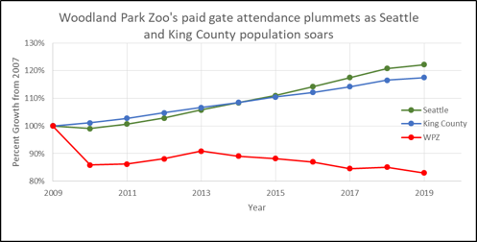
In Seattle, WA, Friends of Woodland Park Zoo Elephants’ (Friends) effort to retire Bamboo, Chai and Watoto, to PAWS sanctuary in CA spanned over a decade. In that time, we helped the public become aware that it is inhumane to cage elephants who are highly intelligent and far-ranging. We believe this allowed people to extend their awareness to include other wild animals. We base that on the fact that paid gate attendance to Woodland Park Zoo has steadily declined for well over a decade. People are getting it!
This graph shows that the 10-year trend is unmistakable and accelerating; people are not paying to go to Woodland Park Zoo in the numbers they used to. In fact, the 2019 paid gate attendance was at the 2004 level despite the population boom in the Seattle/Puget Sound region over the past 15 years. The downward trend is especially precipitous during the last several years. Zoo Memberships have also not kept up with the population boom. This decline included many of the years when the elephants were still in Seattle.
We believe the reason for this downward trend is that the public’s attitudes are changing. This was found to be true in a 2017 survey commissioned by Friends and conducted by GMA Research, a respected national polling company.
Here are two very revealing survey findings:
85% of respondents believe that people are changing the way they think about keeping wild animals in captivity.
Only 1% of respondents said they learned about wild animals by going to the zoo even though the zoo was offered as a choice.
The captivity industry did their own research in 2014. The World Association of Zoos and Aquariums found that actions people would take to protect wild animals and their habitat significantly DECREASED after a zoo visit. In other words, the captivity industry debunked their own time-worn claim that seeing a wild animal in a zoo results in people caring and taking action to advance conservation. It does not.
So there you have it. A visit to a zoo is not about conservation and education but it is primarily for entertainment — on the backs of suffering wild animals.
We know that elephants and all the other wild animals in a zoo retain their wild instincts. It takes generations of selective breeding to domesticate an animal and that’s not what zoos do. This means that everything that is important to a wild animal’s life is denied to them. Caged animals cannot engage in some of the most natural behaviors such as courting, mating, hunting, foraging, digging, burrowing, rubbing up against a tree, running and perhaps the worst of all is that they cannot flee. Caged in a zoo, wild animals suffer physically and psychologically.
Friends had a lot of help which is essential for success. The Seattle Times, for which we were incredibly grateful, did a lot of heavy lifting with seventeen editorials railing against the zoo, writing opinions like, “The business of breeding elephants, displaying them and exploiting them as revenue drivers should end.” Many other media outlets covered Friends’ efforts which helped to spread awareness.
Friends’ left no stone unturned in making the public aware of the plight of the elephants. It used social media, aerial and bus advertising, letter writing (including to zoo donors), calling, banner drops, demonstrating at the zoo and city hall, leafletting, and speaking on TV and radio. We held press conferences and met with the decision makers. All these efforts worked toward making people aware of the suffering taking place right in their own back yard.
All throughout Friends’ campaign, we offered an alternative to the elephants leaving Seattle. In other words, we offered a solution to the void of taking something away. We, along with one Seattle City Councilmember, suggested using technology as the humane way to champion education and the conservation of wildlife. We promoted virtual connection as a way for people to immerse themselves in the lives of wild animals where they live; their triumphs and struggles. This would be a way for people to learn how animals raise their young, how they outwit competitors, how they avoid their enemies and how they play their vital role in keeping the ecosystem healthy. Technology can open worlds utterly beyond the potential of any traditional zoo—and without any of the suffering.
The outcome of our campaign was a tragedy for Bamboo and Chai. Woodland Park Zoo’s management prevailed in sending them to another zoo. But we can claim some success in that the zoo’s goal of becoming an elephant breeding center ended (Chai was artificially inseminated 112 times) with the closure of the elephant exhibit. The long term effects of the negative publicity and the spotlight on how harmful zoo life is for elephants and other wild animals has clearly had an effect. People are voting with their feet and not going to the zoo in the numbers they had in the past.
_________________________
Alyne Fortgang is Co-founder of Friends of Woodland Park Zoo and led the decade-long effort to retire Bamboo, Chai, and Watoto to PAWS sanctuary in California.
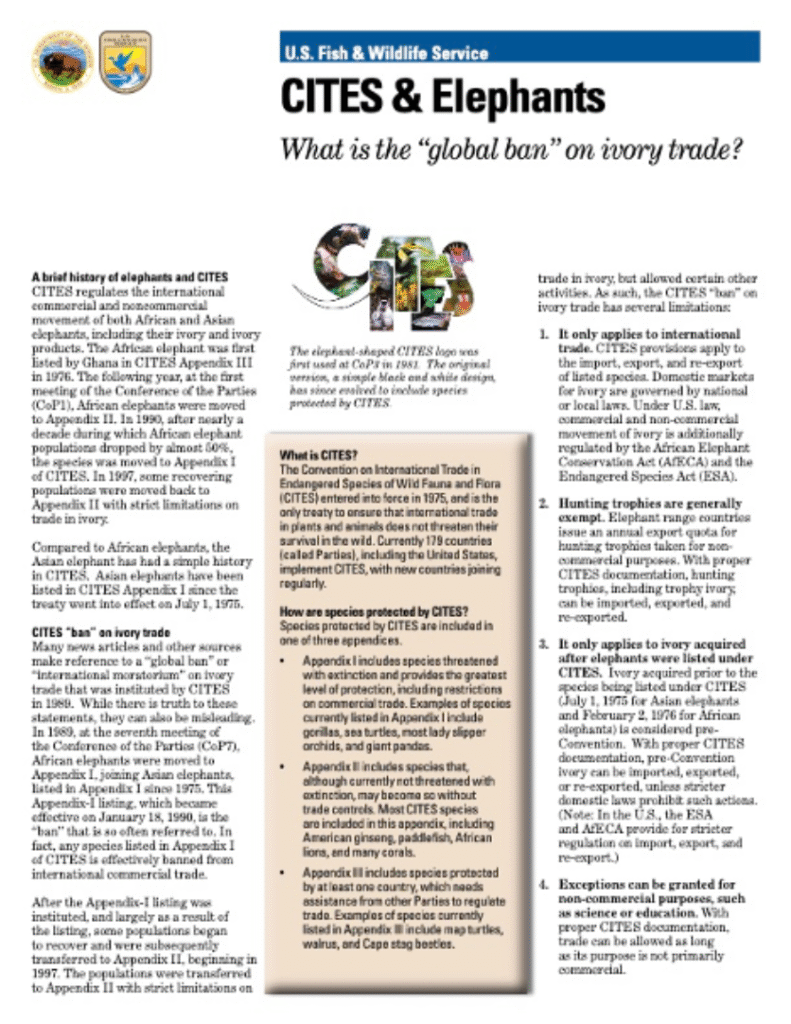
CITES is a large world-body of an organization and stands for Convention on International Trade
In Endangered Species of wild fauna and flora, aimed to ensure that international trade in specimens of wild animals and plants does not threaten their survival. Meetings are held every two to three years somewhere in one of the worlds big cities.
I have been to 4 of these 10-day events. The first one was in 1977, when I traveled to Harare/ Zimbabwe to be an observer for the Oakland Zoo. I paid for my own attendance because I was immensely curious what this international body is all about. Having personally such dedicated interest in elephant welfare and protection I was spiritually pulled to go.
The opening was a spectacular display of cultural performances that kept everyone smiling and clapping. Then president Mugabe opened the conference with a spirited speech.
It was a high-profile conference with heavy focus on elephants. The ivory sale was hotly discussed, emotions ran high and Zimbabwe fought hard for sustainable use. Basically, that means the elephant has to pay for its way to be protected. The people of the country should benefit from the sale of ivory in order to help for their conservation. That was the opinion and mood of many of the delegates, especially the one from Zimbabwe which was large in numbers and full of passion. I will never forget witnessing such strong display of emotions that run so unleashed through the halls of the conference. It was strangely electrifying, I must admit, to find myself amongst delegates who rooted for something I had no heart for.
At that time the conference had about 134 countries (now 184) participating. Each country sends a delegation numbering in the range from 2 to 20 people. Besides the government delegations many wildlife NGO’s are also present. NGO’s are holding meetings and presentations to sway delegates to vote more heart-centered to protect especially vulnerable species. Giving voice to an animal’s right to be respected, saved from exploitation and not viewed as a commodity. I met many world leading figures in elephant conservation. One in particular, Vivek Menon, head of Wildlife Trust of India, became a friend and invited me to practice bodywork on captive Indian elephants.
CITES is a dysfunctional entity where countries with great economic power entice a poor country to vote for a certain proposal in exchange for financial help and investment. It was depressing to sense and hear about the amount of corruption that has been going on for years.
My next CITES visit was in the year 2000 held in Nairobi/ Kenya. I had visitor status this time which did not give me access to all meeting groups but in the large committees I could sit in every day.
Again, I went as a visitor to the 2007 CITES conference in The Hague /Netherlands.
It was a deeply depressing conference with an agreement of an ivory stock pile sale.
See data on the auction below.
My last one was in 2016 which was held in Johannesburg/South Africa. As the previous ones,
Elephant topics dominate and have been prone to the most stressful discussions. African nations like Zimbabwe, Namibia and South Africa have an on-going big interest in getting rid of their ivory stockpiles. Profiting from the Asian demand for ivory is a relentlessly strong drive by this southern African Countries. The wish to decide over their own resources is repeatedly expressed by their representatives.
For instance, ivory stockpiles had been constantly pushed up for sale and so 12 years ago in 2007 a one-off sale of ivory was agreed on by the parties. It proved to be devastating for the African Elephant. Sadly, poaching went up dramatically, benefitting the poaching industry because of the difficulty identifying legal from illegal ivory. Poaching syndicates found often twisted ways with the help of corrupt government officials to smuggle the highly desired ivory to their customers in Asia.
At the end of each conference the parties will vote on a long list of proposals and the result is supposedly binding till the next CITES date. Unfortunately, there are incidents, loopholes which are hardly addressed by this body. A lot has to do with the more recent years of shipping elephant babies from Zimbabwe to China. A cruel, traumatic act of hardship for this young, vulnerable, elephants and very upsetting. The bottom line is that it is a headachy and weak organization that has failed the species it was designed to protect. Enforcement is lacking, perhaps not even doable, unless CITES reforms.
The 2019 conference, which I did not go to, produced a highlight for elephants which was greatly applauded and for some came quite as a surprise.
Elephants from the wild will no longer be shipped to zoos and circuses around the globe, delegates at the 18th Conference of Parties (CoP) to the Convention on International Trade in Endangered Species (CITES) decided on August 27, 2019.Aug 28, 2019
For the reader of this blog my focus has been on elephants only but CITES deals with many other species and I want to leave that to the specific interest of the reader to search for that wider information. Countless animal and plant species on this planet need help and engagement and I applaud anyone whose heart calls for activism.
The words “Ethical Sanctuary” are being used without merit in all parts of the world to make money – Reminds me of the term “Eco” used in many facets in the tourism industry which are not environmentally sound. All three terms used to attract people who are just trying to do the right thing by the planet and animals but lack the knowledge. World Elephant Alliance is working on providing education with an active published list of elephant sanctuaries, rescue, and rehabilitation centers from around the world, detailing what each of them has to offer its elephants.
This will provide needed transparency and guidance for the public.
We asked each member of the World Elephant Alliance to write down what “Sanctuary” means to them. I am an animal communicator so I asked the elephants as a collective what they would like sanctuary to be for them – Here is their response.
Freedom to play – A healthy environment containing nourishment for body and soul.
Low vibration of energy – Openness and sincerity of expression.
Good food – Healthy, fresh.
Plenty of places to scratch on!
Warm climate.
Birds, insects, and animal friends.
Telepathic Communication – With humans.
To be able to teach. We are teachers for humans. Humans think they know everything about us. We are all different in our thoughts.
Playtime – Yes this again. Humans need to do more of this instead of working.
Annette Hadaway is an Internationally known Certified Animal and Nature Communicator animalandnatureconnect.org
Curious about telepathic animal communication? Being With Animals is a documentary film about animal communication by Salome Pitschen featuring my animal communication teacher Dr. Maia Kincaid. Now available to live-stream on Vimeo.
Chendra awaiting sanctuary. Photo Credit: Colin Durfee freeoregonzooelephants.org
Free the Oregon Zoo Elephants (FOZE) announces its campaign to free Chendra, the long-suffering Borneo elephant at the Oregon Zoo. The multi-level campaign publicizes Chendra’s plight on billboards, bus posters, aerial advertising, newspaper inserts and all social media platforms. The campaign asks citizens and taxpayers to demand that Metro and Oregon Zoo officials retire Chendra to live out her life in peace at a sanctuary.
THE PERILS OF CAPTIVITY – Chendra, taken from Malaysia at four years old, suffers from painful, potentially lethal foot fractures common to zoo elephants. Blind in one eye from a past injury, she also suffers from persistent anemia, mycobacteriosis, and severe zoochosis – circling, swaying, rocking — abnormal repetitive behaviors caused by languishing for years in captivity.
RISKY BUSINESS – Despite Chendra being at great risk of contracting tuberculosis from the other infected zoo elephants, the zoo endangered her, a Borneo elephant further, by breeding her with a much larger species of Asian elephant. At the same time that Chendra’s pregnancy was confirmed, she was diagnosed with active tuberculosis, the fifth Oregon Zoo elephant to contract this debilitating disease. In December 2019, Chendra suffered a miscarriage while kept in quarantine for six months. This isolation is cruel for such a highly social and far-ranging animal. The Oregon Zoo, with five elephant deaths in the last five years, is an unsafe location for Chendra.
From Scientific American (February, 2014): “We now have solid evidence that elephants are some of the most intelligent, social and empathic animals around—so how can we justify keeping them in captivity?” “. . . if the zoos really have the animals’ best interests at heart, they would close their elephant exhibits.”
THE PROMISE OF SANCTUARY – Now there is hope that Chendra will get a chance to enjoy the life she was meant to live. A sanctuary in a warm climate in the U.S. has agreed to take her.
“For 12 years, we asked the zoo and Metro to free Packy before he died. Now we demand Chendra’s freedom before it’s too late and her fate is the same as Packy’s” says Courtney Scott, president of Free the Oregon Zoo Elephants.
FOZE invites all Portland area animal lovers to join the Free Chendra campaign, For more details, visit freeoregonzooelephants.org
We had just finished Elephant Aid Internationals 2019 Elephant Footcare Workshop in Sauraha Nepal. EAI founder Carol Buckley, Leslie Schreiber, Lena Quenard and I were enjoying MoMos, a popular Nepalese dish at a local eatery when Carol shared that Mina, one of a few female government mahouts asked if Carol would gift the elderly working elephant in her care, Sundar Mala a blanket to keep her warm. We are told by the government that Sundar Mala is in her mid 70’s.
Although winter day time temperatures can get up to 70F in southern Nepal, night time temperatures can be in the 40’sF. Underweight, elderly, or sick elephants with diseases such as Tuberculosis chained to one area without the ability to move their bodies freely – Enjoy the warmth of a blanket to keep them more comfortable.
The four of us took a moment to think about the quickest way to honor Mina’s request – In the next moment, I remembered an elephant blanket Free The Oregon Zoo Elephants, a non-profit in Portland Oregon U.S.A. tried to gift Chendra, a sick elephant imprisoned at the Oregon zoo. The Oregon zoo refused the blanket, denying the gift from FOZE – Being a core supporter of FOZE I knew the blanket was sitting in a members’ basement. Arrangements with Trish London, a veterinarian traveling to Sauraha from Atlanta Georgia were made. FOZE shipped the blanket to Trish in Georgia who generously offered to bring the blanket to Sauraha Nepal. The blanket arrived in Sauraha less than two weeks’ time!
Sundar Mala’s blanket was the talk of the village! Mahouts and their supervisors started requesting coats for numerous elephants. This action led to Elephant Aid International’s Winter EleCOATS campaign. The campaign was supported by Goat Coat Shop the organization who constructed the blankets. Enough money was raised to construct and ship 2 baby and 4 adult elephant blankets!
Photo Credit/Author – Annette Hadaway, Animal and Nature Connect
On January 4, 2020, World Elephant Alliance, along with 42 other groups from Australia to Zimbabwe, participated in a commemorative service to honor all the elephants who died in captivity in 2019. Ten cities held live vigils with hundreds of vigil goers in eight US cities and in Colombo, Sri Lanka and Cancun, Mexico. Many more held private vigils and shared their vigil photos online.
The number of elephants who died in 2019 is estimated to be higher than the 37 that were commenorated, many more uncounted from Kerala, India for instance. At the vigils, each person read the biography of the deceased elephant, chronicling the sad lives of these captive elephants, who suffered and died in captivity for the purpose of entertainment and tradition. This second annual #vigil4elephants is growing fast. Last year, 8 groups took part, next year will see even more as news of the vigil spreads far and wide.